
Degrees of Adjectives refer to the variations in intensity or comparison that adjectives can express. They help describe the extent or level of a quality attributed to a noun. Adjectives in English can be categorized into three main degrees: positive, comparative, and superlative. Each degree plays a unique role in comparing things, whether it’s showing a simple quality, a comparison between two things, or highlighting the highest level of a characteristic among several. Understanding these degrees is essential for constructing accurate and expressive sentences. Let’s explore the definitions and examples of each degree in more detail.
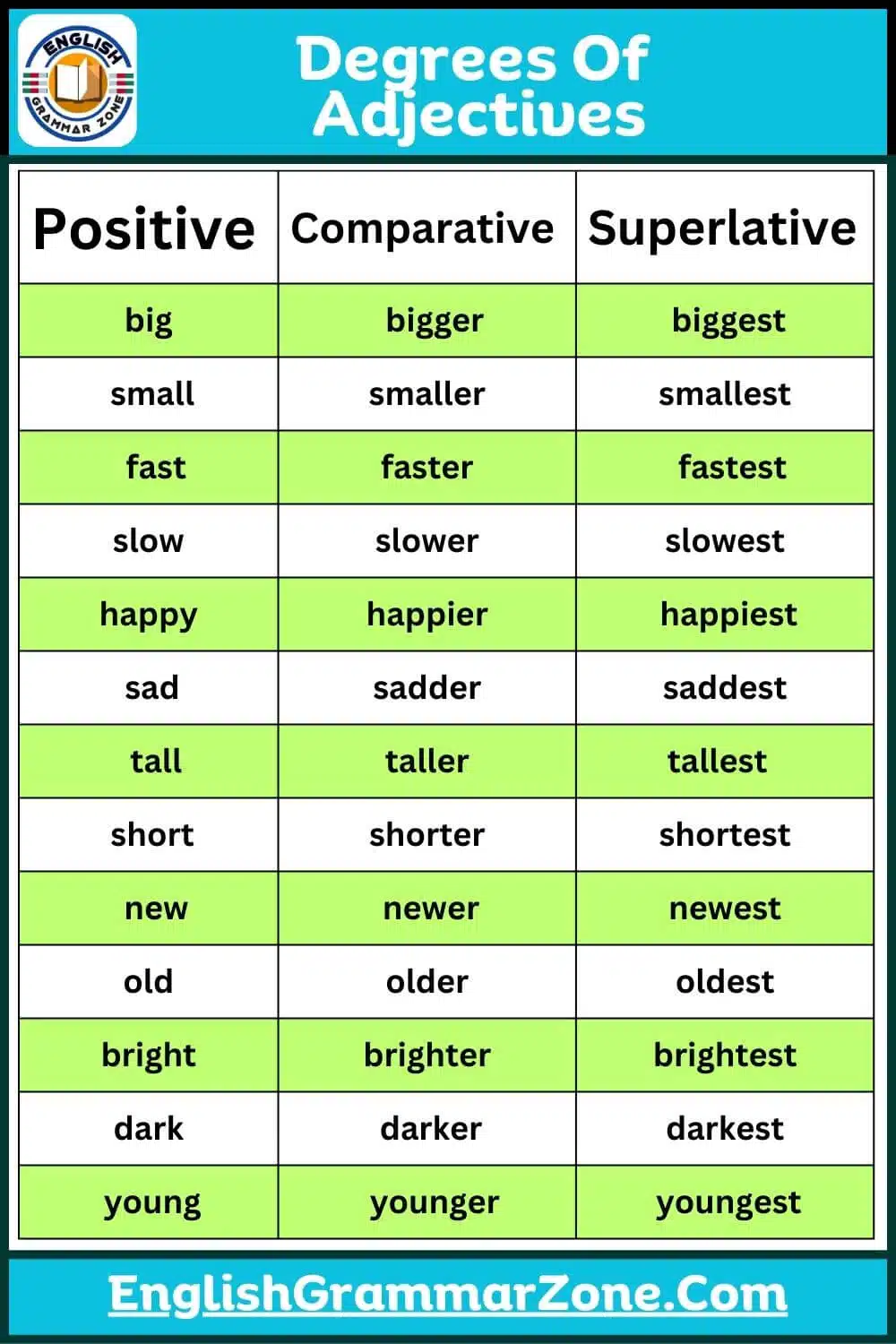
Degrees Of Adjectives
| Positive | Comparative | Superlative |
| big | bigger | biggest |
| small | smaller | smallest |
| fast | faster | fastest |
| slow | slower | slowest |
| happy | happier | happiest |
| sad | sadder | saddest |
| tall | taller | tallest |
| short | shorter | shortest |
| new | newer | newest |
| old | older | oldest |
| bright | brighter | brightest |
| dark | darker | darkest |
| young | younger | youngest |
| rich | richer | richest |
| poor | poorer | poorest |
| strong | stronger | strongest |
| weak | weaker | weakest |
| clean | cleaner | cleanest |
| dirty | dirtier | dirtiest |
| loud | louder | loudest |
| quiet | quieter | quietest |
| brave | braver | bravest |
| lazy | lazier | laziest |
| busy | busier | busiest |
| pretty | prettier | prettiest |
| ugly | uglier | ugliest |
| easy | easier | easiest |
| difficult | more difficult | most difficult |
| cheap | cheaper | cheapest |
| expensive | more expensive | most expensive |
| near | nearer | nearest |
| far | farther | farthest |
| early | earlier | earliest |
| late | later | latest |
| heavy | heavier | heaviest |
| light | lighter | lightest |
| thick | thicker | thickest |
| thin | thinner | thinnest |
| deep | deeper | deepest |
| shallow | shallower | shallowest |
| wide | wider | widest |
| narrow | narrower | narrowest |
| large | larger | largest |
| small | smaller | smallest |
| cold | colder | coldest |
| hot | hotter | hottest |
| clear | clearer | clearest |
| dark | darker | darkest |
| simple | simpler | simplest |
| complex | more complex | most complex |
| safe | safer | safest |
| dangerous | more dangerous | most dangerous |
| comfortable | more comfortable | most comfortable |
| uncomfortable | more uncomfortable | most uncomfortable |
| interesting | more interesting | most interesting |
| boring | more boring | most boring |
| popular | more popular | most popular |
| unpopular | more unpopular | most unpopular |
| famous | more famous | most famous |
| infamous | more infamous | most infamous |
| friendly | friendlier | friendliest |
| unfriendly | more unfriendly | most unfriendly |
| kind | kinder | kindest |
| cruel | crueller | cruellest |
| healthy | healthier | healthiest |
| unhealthy | unhealthier | unhealthiest |
| beautiful | more beautiful | most beautiful |
| ugly | uglier | ugliest |
| generous | more generous | most generous |
| selfish | more selfish | most selfish |
| honest | more honest | most honest |
| dishonest | more dishonest | most dishonest |
| clever | cleverer | cleverest |
| stupid | more stupid | most stupid |
| polite | more polite | most polite |
| impolite | more impolite | most impolite |
| creative | more creative | most creative |
| dull | duller | dullest |
| energetic | more energetic | most energetic |
| tired | tireder | tiredest |
| organized | more organized | most organized |
| disorganized | more disorganized | most disorganized |
| peaceful | more peaceful | most peaceful |
| violent | more violent | most violent |
| careful | more careful | most careful |
| careless | more careless | most careless |
| supportive | more supportive | most supportive |
| unsupportive | more unsupportive | most unsupportive |
| imaginative | more imaginative | most imaginative |
| practical | more practical | most practical |
| impractical | more impractical | most impractical |
| logical | more logical | most logical |
| illogical | more illogical | most illogical |
| realistic | more realistic | most realistic |
| unrealistic | more unrealistic | most unrealistic |
| funny | funnier | funniest |
| serious | more serious | most serious |
| respectful | more respectful | most respectful |
| disrespectful | more disrespectful | most disrespectful |

Degrees of Adjectives
Adjectives are words that describe or modify nouns. They provide more information about a noun, such as its size, shape, color, or quality. In English, adjectives can be used in different degrees to compare one thing to another. These degrees are known as the positive, comparative, and superlative forms.
Positive Degree
The positive degree of an adjective is the simplest form. It describes a single noun without comparing it to anything else. It is used when no comparison is made.
Examples:
- She is tall.
- This book is interesting.
- He is kind.
Comparative Degree
The comparative degree of an adjective is used to compare two nouns. It often ends in “-er” for short adjectives or uses the word “more” before the adjective for longer adjectives.
Rules for Forming the Comparative Degree:
- For most one-syllable adjectives, add “-er”:
- taller
- fast → faster
- For one-syllable adjectives ending in a single consonant with a single vowel before it, double the consonant and add “-er”:
- big → bigger
- hot → hotter
- For two-syllable adjectives ending in “y,” change “y” to “i” and add “-er”:
- happy → happier
- easy → easier
- For adjectives with two or more syllables, use “more” before the adjective.
- beautiful → more beautiful
- comfortable → more comfortable
Examples:
- She is taller than her brother.
- This book is more interesting than the last one.
- He is kinder than his friend.
Superlative Degree
The superior degree of an adjective is used to compare three or more nouns. It often ends in “-est” for short adjectives or uses the word “most” before the adjective for longer adjectives.
Rules for Forming the Superior Degree:
- For most one-syllable adjectives, add “-est.”
- tall → tallest
- fast → fastest
- For one-syllable adjectives ending in a single consonant with a single vowel before it, double the consonant and add “-est.”
- big → biggest
- hot → hottest
- For two-syllable adjectives ending in “y,” change “y” to “i” and add “-est.”
- happy → happiest
- easy → easiest
- For adjectives with two or more syllables, use “most” before the adjective.
- beautiful → most beautiful
- comfortable → most comfortable
Examples:
- She is the tallest in her class.
- This is the most interesting book I’ve ever read.
- He is the kindest person I know.
Irregular Adjectives
Some adjectives have irregular comparative and superlative forms that do not follow the standard rules.
Examples:
- good→ better→ best
- bad → worse → worst
- far → farther → farthest (or further → furthest)

