
Collocations are an essential part of mastering any language, and English is no exception. If you want to sound natural and fluent, understanding and using collocation examples is key. In simple terms, collocations are combinations of words that are commonly used together and sound “right” to native speakers. For instance, native English speakers say “strong coffee” instead of “powerful coffee” or “make a decision” rather than “do a decision.”
Mastering collocations can greatly improve your fluency, making your speech and writing sound more natural and easier to understand. This article provides 100 collocation examples that will help you get a firm grasp on this vital aspect of English. But don’t just memorize them—use them in context, and you’ll be well on your way to sounding like a native speaker.
What are Collocations?
Before we dive into the examples, let’s clarify what collocations are. As mentioned earlier, collocations are word combinations that occur together naturally. Some collocations are fixed, meaning they rarely change, while others are more flexible. For example, we often say “take a break”, but you wouldn’t say “take a rest” in the same context.
Understanding collocations allows learners to:
Sound more fluent and natural
Avoid awkward or incorrect word choices
Improve comprehension when listening to or reading English
Types of Collocations
Collocations come in various forms. Below are some of the most common types:
Verb + Noun: These collocations involve a verb and a noun that often appear together. For example: “make a decision,” “take a risk,” and “catch a cold.”
Adjective + Noun: These combinations consist of an adjective and a noun. Examples include “strong coffee,” “high expectations,” and “rich flavor.”
Adverb + Adjective: These collocations are made up of an adverb modifying an adjective. Some examples are “extremely important,” “highly successful,” and “deeply concerned.”
Noun + Noun: These are combinations of two nouns. Examples include “traffic jam,” “business meeting,” and “family member.”
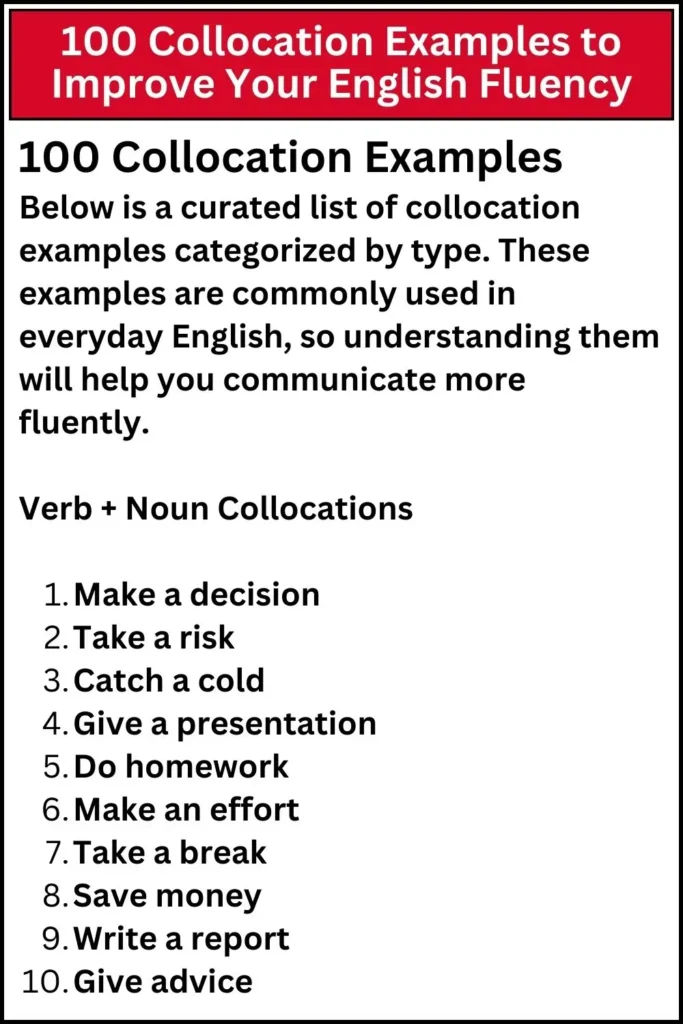
100 Collocation Examples
Below is a curated list of collocation examples categorized by type. These examples are commonly used in everyday English, so understanding them will help you communicate more fluently.
Verb + Noun Collocations
Make a decision
Take a risk
Catch a cold
Give a presentation
Do homework
Make an effort
Take a break
Save money
Write a report
Give advice
Adjective + Noun Collocations
Strong coffee
Heavy rain
Bright idea
High hopes
Rich history
Big problem
Deep sleep
Cold weather
Loud noise
Tough decision
Adverb + Adjective Collocations
Highly successful
Extremely important
Perfectly balanced
Deeply concerned
Totally unexpected
Completely different
Barely visible
Really happy
Absolutely necessary
Very careful
Noun + Noun Collocations
Business meeting
Traffic jam
Family member
Project manager
Student loan
Movie ticket
Coffee break
Office building
Phone call
Birthday party
80 Collocations Examples And Their Sentences :
| Collocation | Example Sentence |
|---|---|
| Make a decision | She had to make a decision about her career path. |
| Take a break | I think it’s time to take a break after all that hard work. |
| Do homework | He forgot to do his homework last night. |
| Have a conversation | They had a conversation about their weekend plans. |
| Give a presentation | She will give a presentation at the conference tomorrow. |
| Take a risk | Starting your own business is always a risk. |
| Make an effort | She really made an effort to improve her skills. |
| Catch a bus | I missed my chance to catch a bus this morning. |
| Break the news | It was difficult for him to break the news to his friend. |
| Lose weight | He has been trying to lose weight by eating healthy. |
| Gain experience | This internship will help me gain experience in marketing. |
| Make a mistake | Everyone makes mistakes from time to time. |
| Take a chance | Sometimes, you have to take a chance if you want to succeed. |
| Save money | She is trying to save money for a vacation. |
| Give advice | My mentor gave me advice on how to succeed in my career. |
| Make a promise | He made a promise to always support his family. |
| Have a party | They decided to have a party to celebrate their anniversary. |
| Take a shower | I need to take a shower before the meeting. |
| Make a mistake | I always try not to make mistakes when presenting. |
| Hold a meeting | The manager will hold a meeting to discuss the project. |
| Go on a trip | I can’t wait to go on a trip next summer. |
| Take part | She loves to take part in charity events. |
| Make a decision | It’s hard to make a decision when there are so many options. |
| Play a role | He played a role in the success of the project. |
| Take advantage | You should take advantage of the sale while it lasts. |
| Give a speech | The president will give a speech about the new policy. |
| Work hard | He worked hard to get promoted. |
| Have an impact | Her speech had a lasting impact on the audience. |
| Pay attention | Please pay attention to the details in this document. |
| Set a goal | She set a goal to run a marathon this year. |
| Make a suggestion | I would like to make a suggestion for improving this plan. |
| Take it easy | After the stressful week, it’s time to take it easy. |
| Go to bed | It’s getting late. I think I will go to bed soon. |
| Do business | Our company is looking to do business in Asia. |
| Catch a cold | I think I caught a cold after being out in the rain. |
| Do a favor | Can you do me a favor and pick up the groceries? |
| Make a change | She wants to make a change in her career. |
| Have fun | I hope you have fun at the party tonight! |
| Take time off | I need to take time off to rest and recover. |
| Give someone a hand | Could you give me a hand with moving this box? |
| Make progress | The team is starting to make progress on the new project. |
| Take notice | We should take notice of the new company policy. |
| Get in touch | I’ll get in touch with you later to confirm the details. |
| Go wrong | Everything went wrong during the event. |
| Give a hug | He was happy to give his mom a hug after being apart for so long. |
| Take control | The manager decided to take control of the situation. |
| Do your best | Always do your best in everything you do. |
| Make a complaint | I had to make a complaint about the poor service. |
| Take a photo | She loves to take photos when traveling. |
| Give someone a call | I’ll give you a call once I arrive. |
| Make a reservation | I need to make a reservation for dinner tonight. |
| Have a conversation | I need to have a conversation with you about the proposal. |
| Take action | It’s time to take action and move forward with the plan. |
| Make peace | They finally made peace after their long disagreement. |
| Take a seat | Please take a seat while you wait for your appointment. |
| Do the laundry | I need to do the laundry before the weekend. |
| Make an impression | She really made an impression with her amazing presentation. |
| Take a deep breath | Before speaking, take a deep breath to calm down. |
| Give a lift | Can you give me a lift to the airport? |
| Make an observation | I’d like to make an observation about this issue. |
| Have an idea | Do you have any idea where I left my keys? |
| Take care | I hope you take care and feel better soon. |
| Make up your mind | You need to make up your mind whether you want to go or not. |
| Do the dishes | It’s your turn to do the dishes tonight. |
| Make a reservation | I need to make a reservation at the restaurant for us. |
| Take charge | She was quick to take charge of the project. |
| Give someone a break | After working nonstop, it’s time to give him a break. |
| Make a deal | They made a deal with the supplier for a lower price. |
| Take responsibility | He took responsibility for the mistake in the report. |
| Have breakfast | I usually have breakfast at 7 AM before heading to work. |
| Make a call | I need to make a call to confirm the reservation. |
| Have an argument | They had an argument over what movie to watch. |
| Take part in | I would love to take part in the competition. |
| Do your homework | He forgot to do his homework before going out with his friends. |
| Make a promise | I made a promise to always be there for her. |
| Take advantage | We should take advantage of the low prices before the sale ends. |
| Give someone advice | She gave me advice on how to improve my resume. |
| Make an offer | He made an offer on the house, but it was rejected. |
How to Learn Collocations Effectively
Understanding collocation examples is one thing, but mastering them is another. Here’s a step-by-step guide on how to learn and incorporate collocations into your daily language use.
1. Read Extensively
Reading books, newspapers, and online articles exposes you to natural language use. This will help you notice which words are often used together. Whenever you encounter a new collocation, try to understand the context in which it is used.
2. Use Collocation Dictionaries
Specialized dictionaries like the Oxford Collocations Dictionary and Macmillan Collocations Dictionary can be a goldmine for finding common word pairings. These dictionaries provide real-world examples of collocations, making them an excellent resource.
3. Practice Regularly
Consistency is key. Incorporate new collocations into your daily writing and speaking. Whether you’re writing an essay, composing an email, or chatting with a friend, make it a habit to use these combinations. The more you practice, the more natural they’ll become.
4. Listen to Native Speakers
Listening to native speakers is a great way to internalize collocations. Watch movies, TV shows, or podcasts and pay attention to how they use collocations in different contexts. If you’re not sure about a particular combination, look it up or ask a native speaker.
5. Keep a Collocation List
As you encounter new collocations, write them down in a notebook or on your phone. Organize them into categories like Verb + Noun or Adjective + Noun to make it easier to review them later.
Conclusion On Collocation examples
Mastering collocations is one of the most effective ways to sound more natural in English and improve your language skills overall. Whether you’re writing, speaking, or listening, understanding and using common collocations will make your communication more fluent and precise. By applying the strategies shared in this article—such as reading extensively, using collocation dictionaries, practicing daily, and listening to native speakers—you can quickly become more comfortable with these word pairings. So, start incorporating collocation examples into your daily practice, and watch your fluency soar!
FAQs On Collocations Examples in English
1. What are collocations in English?
Collocations are combinations of words that are often used together in natural English. They sound natural to native speakers but may not always follow logical rules of grammar. For example, we say “make a decision” instead of “do a decision,” or “strong coffee” rather than “powerful coffee.”
2. Why are collocations important in learning English?
Collocations are important because they help you sound more natural and fluent when speaking or writing in English. By learning common word combinations, you will be able to express yourself more clearly and with greater ease, making your communication more effective.
3. How can I learn collocations effectively?
To learn collocations effectively, read extensively in English, use collocation dictionaries, listen to native speakers, and practice regularly by writing and speaking. Grouping collocations by topics and using flashcards are also helpful techniques for retention.
4. What are some common examples of collocations in English?
Some common examples of collocations include:
Make a decision
Take a break
Heavy rain
Do homework
Fast food
5. What mistakes should I avoid when using collocations?
Common mistakes include using incorrect verb-noun combinations, like saying “do a decision” instead of “make a decision,” or using adjectives that don’t naturally fit with the noun, like saying “heavy food” instead of “heavy meal.” Avoid relying solely on simple collocations and try to expand your vocabulary.
