When preparing for the IELTS Speaking Test, one of the most effective ways to enhance your speaking ability is by mastering idioms. Idioms are figurative expressions that give your speech a more natural, engaging, and native-like quality. They help you convey ideas in a creative way, showcasing your vocabulary range and language proficiency, which is a key component of the IELTS Speaking band scores. This guide will explore what idioms are, why they are crucial for the IELTS Speaking Test, and how to use them effectively to boost your score.
What Are Idioms for IELTS Speaking?
Idioms are phrases or expressions whose meanings are different from the literal meanings of the words used. They often reflect cultural nuances and offer a way to express complex ideas in a simple, yet colorful manner. For example, when someone says they are “feeling under the weather,” they don’t mean they’re literally under the weather—they simply feel ill.
In the IELTS Speaking Test, your ability to use idiomatic expressions appropriately can significantly impact your score. Examiners are keen to assess your vocabulary and fluency, and incorporating idioms naturally into your speech demonstrates advanced language skills. Knowing when and how to use idioms is essential for expressing yourself more effectively.
Why Are Idioms Important for IELTS Speaking?
Using idioms can make your speaking responses sound more natural and native-like, which is highly valued in the IELTS Speaking Test. Here’s why idioms are so important:
- Shows Vocabulary Proficiency: Idioms allow you to demonstrate a rich range of vocabulary, showcasing your ability to use complex and diverse language.
- Improves Fluency: Native speakers often use idiomatic expressions in everyday conversation, so using them appropriately in the IELTS test will make you sound more fluent and natural.
- Clarifies Meaning: Idioms often carry deeper meanings that can help you express your ideas more clearly and persuasively, enhancing the overall effectiveness of your communication.
- Enhances Band Score: Your lexical resource is a critical part of the IELTS Speaking score. Using idioms shows that you can handle both basic and advanced language, which can positively influence your band score.
How to Use Effectively Idioms for IELTS Speaking
While idioms are a powerful tool, it’s essential to use them correctly to avoid sounding forced or unnatural. Here are some tips for using idioms effectively in the IELTS Speaking Test:
1. Don’t Overuse Idioms
Using too many idioms in a single response can make your speech sound unnatural and overdone. Aim to use one or two idioms per answer, depending on the context. Overloading your speech with idiomatic expressions can detract from your message and confuse the examiner.
- Tip: Use idioms where they naturally fit in the context. They should enhance your answer, not overwhelm it.
2. Context Matters
Each idiom has a specific context in which it works best. If you use an idiom in an inappropriate context, it may not only sound awkward but could also negatively affect your score. For example, using “barking up the wrong tree” when discussing a serious topic like education may seem out of place.
- Tip: Make sure that the idioms you use align with the topic and tone of the question.
3. Learn Proper Pronunciation
Mispronouncing idioms can impact your score, as pronunciation is one of the IELTS Speaking test criteria. Practice the pronunciation of idioms until you feel confident. If you’re unsure about an idiom’s pronunciation, use online resources to hear how native speakers say it.
- Tip: Listen to native English content like movies, podcasts, or news shows to familiarize yourself with how idioms are used and pronounced.
4. Avoid Overused Idioms
Certain idioms are so common that they may come across as clichéd if used too frequently. Phrases like “in my opinion” or “at the end of the day” are often seen as overused. Instead, opt for more specific or advanced idiomatic expressions that reflect a deeper understanding of the language.
- Tip: Explore less common idioms to stand out during the test and demonstrate a higher level of language proficiency.
5. Be Prepared for Their Meaning
It’s important to understand the figurative meaning of each idiom you plan to use. Using an idiom without fully understanding its meaning or context could make your response sound confusing or out of place.
- Tip: Always learn the meaning, context, and usage of an idiom before using it in your speech.
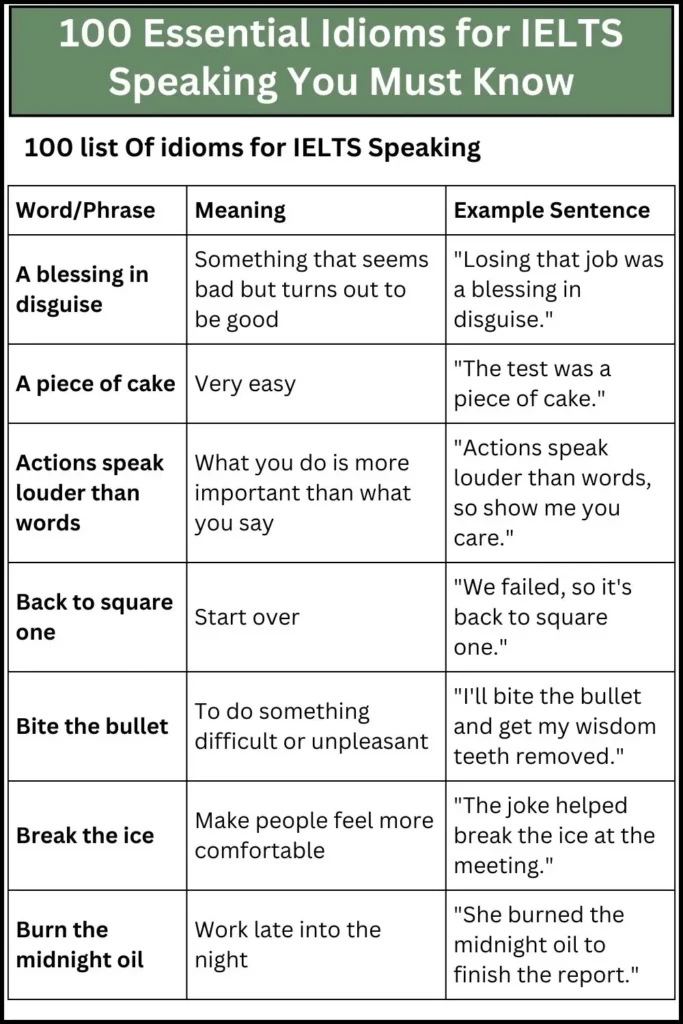
100 list Of idioms for IELTS Speaking
| Word/Phrase | Meaning | Example Sentence |
|---|---|---|
| A blessing in disguise | Something that seems bad but turns out to be good | “Losing that job was a blessing in disguise.” |
| A piece of cake | Very easy | “The test was a piece of cake.” |
| Actions speak louder than words | What you do is more important than what you say | “Actions speak louder than words, so show me you care.” |
| Back to square one | Start over | “We failed, so it’s back to square one.” |
| Bite the bullet | To do something difficult or unpleasant | “I’ll bite the bullet and get my wisdom teeth removed.” |
| Break the ice | Make people feel more comfortable | “The joke helped break the ice at the meeting.” |
| Burn the midnight oil | Work late into the night | “She burned the midnight oil to finish the report.” |
| Cry over spilled milk | Complain about a loss from the past | “There’s no use crying over spilled milk.” |
| Cut corners | Do something poorly to save time or money | “He got into trouble at work for cutting corners.” |
| Don’t count your chickens before they hatch | Don’t assume something will happen before it does | “Don’t count your chickens before they hatch, the deal is not final.” |
| Hit the nail on the head | Do or say something exactly right | “You hit the nail on the head with your analysis.” |
| In the same boat | In the same situation | “We are all in the same boat regarding the deadline.” |
| It’s not rocket science | It’s not complicated | “Just follow the instructions; it’s not rocket science.” |
| Let the cat out of the bag | Reveal a secret | “She let the cat out of the bag about the surprise party.” |
| Make a mountain out of a molehill | Exaggerate a small problem | “She made a mountain out of a molehill with this issue.” |
| Once in a blue moon | Very rarely | “We only see each other once in a blue moon.” |
| Out of the blue | Unexpectedly | “She called me out of the blue.” |
| Play it by ear | Decide as you go | “Let’s play it by ear and see what happens.” |
| Put all your eggs in one basket | Relying on one thing instead of diversifying | “I wouldn’t put all my eggs in one basket with this investment.” |
| Spill the beans | Reveal a secret | “She spilled the beans about the surprise party.” |
| Take it with a grain of salt | Don’t take it too seriously | “Take his advice with a grain of salt.” |
| The ball is in your court | It’s your decision or responsibility to act | “I’ve done my part; now the ball is in your court.” |
| The best of both worlds | An ideal situation | “She has the best of both worlds: a great career and a happy family.” |
| The early bird catches the worm | Success comes to those who prepare well | “She always gets up early; the early bird catches the worm.” |
| The last straw | The final problem in a series of problems | “Her rude comment was the last straw.” |
| The whole nine yards | Everything, all the way | “She went the whole nine yards for her wedding.” |
| Throw in the towel | Give up | “He threw in the towel after a tough match.” |
| Time flies when you’re having fun | Time seems to pass quickly during enjoyable activities | “I can’t believe it’s already midnight. Time flies when you’re having fun.” |
| Turn a blind eye | Ignore something | “The manager turned a blind eye to the minor infraction.” |
| Under the weather | Not feeling well | “I’m feeling a bit under the weather today.” |
| Up in the air | Uncertain | “The decision is still up in the air.” |
| Water under the bridge | Something in the past that is no longer important | “Let’s forget about the past; it’s water under the bridge.” |
| When pigs fly | Never | “He’ll clean his room when pigs fly.” |
| Wrap your head around something | Understand something complicated | “It’s hard to wrap my head around these new regulations.” |
| You can say that again | That’s true; I agree | “This weather is awful! You can say that again.” |
| You can’t judge a book by its cover | Don’t judge by appearances | “She may seem quiet, but you can’t judge a book by its cover.” |
| Your call | Your decision | “It’s your call whether we stay or leave.” |
| Your guess is as good as mine | I have no idea | “When will we get the results? Your guess is as good as mine.” |
| A penny for your thoughts | Asking someone what they are thinking | “You seem quiet. A penny for your thoughts?” |
| A dime a dozen | Something common and not special | “Souvenirs are a dime a dozen in tourist areas.” |
| A perfect storm | The worst possible situation | “It was a perfect storm of bad luck and poor planning.” |
| Beat around the bush | Avoid saying what you mean | “Stop beating around the bush, and tell me what you really think.” |
| Better late than never | It’s better to do something late than not do it at all | “She finally turned in her assignment; better late than never.” |
| Bite off more than you can chew | Take on more than you can handle | “He bit off more than he could chew by accepting two jobs.” |
| Break a leg | Good luck | “Break a leg at your performance tonight!” |
| Break the bank | Spend all your money | “The vacation will break the bank if we stay in a luxury hotel.” |
| Break the ice | Make people feel more comfortable | “The joke helped to break the ice at the meeting.” |
| Bring home the bacon | To earn a living | “He works hard to bring home the bacon.” |
| Burn bridges | Destroy relationships | “Don’t burn bridges by being rude.” |
| Burn the midnight oil | Work late into the night | “She burned the midnight oil to finish her report.” |
| Call it a day | Stop working for the day | “I’m tired; let’s call it a day.” |
| Call it a night | Stop working for the evening | “Let’s call it a night and finish tomorrow.” |
| Costs an arm and a leg | Very expensive | “The new car costs an arm and a leg.” |
| Cross that bridge when you come to it | Deal with a problem when it arises | “We’ll cross that bridge when we come to it.” |
| Curiosity killed the cat | Being inquisitive can lead to trouble | “Be careful with your questions; curiosity killed the cat.” |
| Cut somebody some slack | Don’t be so critical | “Cut him some slack; he’s having a rough week.” |
| Cutting corners | Doing something poorly to save time or money | “He got into trouble at work for cutting corners on safety.” |
| Devil’s advocate | Argue for the sake of it | “I’ll play devil’s advocate and question your assumptions.” |
| Down in the dumps | Feeling sad or depressed | “He’s been down in the dumps since he lost his job.” |
| Draw the line | Set a limit | “We need to draw the line at disruptive behavior.” |
| Easy does it | Slow down | “Easy does it! There’s no need to rush.” |
| Elephant in the room | An obvious problem that’s being ignored | “We need to address the elephant in the room.” |
| Every cloud has a silver lining | There’s something good in every bad situation | “After losing his job, he found a better one. Every cloud has a silver lining.” |
| Feeling under the weather | Feeling ill | “I’m feeling a bit under the weather today.” |
| Get out of hand | Get out of control | “The party got out of hand, and the police were called.” |
| Get your act together | Work better or leave | “You need to get your act together if you want to stay employed.” |
| Give someone the benefit of the doubt | Trust what someone says | “I don’t think he meant to hurt you; give him the benefit of the doubt.” |
| Go the extra mile | Make an extra effort | “She’s always willing to go the extra mile for her friends.” |
| Hang in there | Don’t give up | “I know it’s tough, but hang in there.” |
Difference Between IELTS Idioms and Phrases
In the IELTS Speaking Test, both idioms and phrases play an important role in demonstrating your language proficiency. However, there are key differences between the two. Understanding these differences will help you use them more effectively and appropriately during your test.
| Aspect | Idioms | Phrases |
|---|---|---|
| Definition | Idioms are expressions where the meaning is not literal. They often carry a figurative meaning. | Phrases are groups of words that have a specific meaning and can be literal or figurative. |
| Context | Idioms are often used in informal or conversational settings. | Phrases can be used in both formal and informal contexts. |
| Meaning | Idioms often have a meaning that is not easily understood from the individual words. | Phrases are more direct and their meaning can be easily understood from the individual words. |
| Purpose | Idioms add color, creativity, and emphasis to speech, often making it sound more native-like. | Phrases help to convey ideas clearly and effectively, making communication more precise. |
| Flexibility | Idioms are often culture-specific and may not translate well across languages. | Phrases are generally universal and easier to understand across different cultures. |
| Use in IELTS Speaking | Using idioms in IELTS Speaking can showcase your ability to use creative language. However, they should be used appropriately and sparingly. | Phrases are more common in IELTS Speaking and can be used to express ideas clearly and effectively. |
Examples
- Idioms: “A blessing in disguise,” “Bite the bullet,” “Break the ice”
- Phrases: “In my opinion,” “At the end of the day,” “As far as I’m concerned”
Takeaways
- Idioms are more figurative and often used to add emphasis or express ideas in a creative way, but they must be used carefully to avoid sounding forced or inappropriate.
- Phrases are more straightforward and versatile, suitable for both formal and informal conversations. They can make your communication more effective and are easy to understand.
Understanding the difference between idioms and phrases is essential to making your IELTS Speaking responses sound natural and fluent. Be sure to use idioms strategically and focus on clear communication with well-chosen phrases.
Most Popular 30 Phrasal Verbs to Help You for the IELTS Speaking Exam
Phrasal verbs are combinations of verbs and prepositions or adverbs that often carry a meaning different from the literal meaning of the individual words. They are essential for sounding natural and fluent in the IELTS Speaking Test, as native speakers use them frequently. Here’s a list of the 30 most popular phrasal verbs that can help you during your IELTS Speaking exam.
| Phrasal Verb | Meaning | Example Sentence |
|---|---|---|
| Break down | Stop functioning (usually machinery) | “My car broke down on the way to work.” |
| Bring up | Mention a topic | “She brought up the issue during the meeting.” |
| Call off | Cancel | “They called off the wedding due to unforeseen circumstances.” |
| Carry on | Continue doing something | “Despite the interruption, he carried on with his presentation.” |
| Come across | Find unexpectedly | “I came across an old friend at the mall yesterday.” |
| Find out | Discover | “I need to find out what time the movie starts.” |
| Get along | Have a good relationship | “They get along well with each other.” |
| Give up | Stop trying | “He gave up smoking last year.” |
| Go on | Continue | “Please go on with your story.” |
| Look after | Take care of | “She looks after her younger brother.” |
| Look forward to | Anticipate with pleasure | “I look forward to meeting you.” |
| Make up | Invent, lie about something | “She made up a story to cover her absence.” |
| Pick up | Collect or lift | “I need to pick up my dry cleaning.” |
| Put off | Postpone | “We had to put off the meeting until next week.” |
| Run into | Meet unexpectedly | “I ran into my teacher at the supermarket.” |
| Set up | Arrange, organise | “They set up a new company last year.” |
| Take after | Resemble a family member | “He takes after his mother in looks.” |
| Take off | Remove (clothing) | “Please take off your shoes before entering.” |
| Turn down | Reject | “She turned down the job offer.” |
| Turn up | Appear or arrive | “He turned up late to the party.” |
| Break up | End a relationship | “They decided to break up after five years together.” |
| Bring about | Cause to happen | “The new law brought about significant changes in education.” |
| Catch up | Get updated or make up for lost time | “Let’s catch up after work!” |
| Check out | Examine or inspect | “Check out the new exhibit at the museum.” |
| Cut down on | Reduce in amount | “I need to cut down on sugar to stay healthy.” |
| Fill in | Complete a form or document | “Please fill in the application form before submitting.” |
| Give in | Surrender or yield to something | “After hours of discussion, they gave in to the proposal.” |
| Go through | Review or examine in detail | “Let’s go through the report before the meeting.” |
| Keep up with | Stay informed or continue at the same level | “I struggle to keep up with all the work.” |
| Look into | Investigate | “The manager will look into your concerns.” |
| Make out | Understand or hear something with difficulty | “I can’t make out what she’s saying with all that noise.” |
Why Are Phrasal Verbs Important for the IELTS Speaking Test?
Using phrasal verbs correctly in your IELTS Speaking test helps to:
- Demonstrate fluency: Native speakers use phrasal verbs in everyday conversation, so using them correctly will make you sound more natural and fluent.
- Show your vocabulary range: Being able to use a variety of phrasal verbs accurately will impress the examiner and show that you have a good command of English.
- Improve your overall score: Your lexical resource is an important criterion in the IELTS Speaking Test. The ability to use phrasal verbs correctly will demonstrate your advanced language skills.
FAQs On Idioms for IELTS Speaking
1. What Are Idioms and Why Are They Important for the IELTS Speaking Test?
Idioms are expressions where the meaning is different from the literal meaning of the words. They are important in IELTS Speaking because they demonstrate your fluency, vocabulary range, and cultural awareness, all of which are key factors in scoring higher.
2. How Can I Practice Using Idioms for the IELTS Speaking Test?
You can practice using idioms by incorporating them into your daily conversations, recording your answers to practice questions, and watching English content where idioms are used. Consistent practice will help you use idioms naturally during the exam.
3. Can Overusing Idioms Hurt My IELTS Speaking Score?
Yes, using too many idioms can make your speech sound unnatural. It’s important to use idioms strategically and not overdo it. Aim for one or two idioms per answer to enhance your fluency without overloading your response.
4. Should I Use Informal Idioms in the IELTS Speaking Test?
While some idioms are informal, it’s important to use idioms that suit the context. For example, more casual idioms like “hit the sack” might not be appropriate in all situations. Choose idioms based on the formality of the question.
5. How Do I Choose the Right Idioms to Use in the IELTS Speaking Test?
Choose idioms that fit the context of the question. Avoid using idioms that are too complex or obscure. Practice using commonly understood idioms, and ensure they enhance your message without sounding forced.