
Language evolves constantly, offering us opportunities to refine our communication skills. Among the less common linguistic features are verbs that end with V. While these verbs are rare in English, they carry unique meanings and applications that enrich our vocabulary. In this article, we will explore verbs that end with V examine their usage, provide examples, and offer exercises to help you master them.
verbs that end with V are fascinating because they often stem from specific linguistic roots or contexts. For instance, many of these verbs have Latin origins or are derived from technical or scientific terminologies. Understanding these verbs can enhance your writing and speaking abilities, making your language more precise and engaging.
What Are Verbs That End With V?
Verbs are action words that describe what someone or something does. verbs that end with V are unique in English because of their limited number and specialized usage. These verbs often appear in formal contexts or specific disciplines such as science, law, or technology.
Terms
Base Form: The original form of a verb (e.g., rev).
Past Tense: The form used to describe actions that occurred in the past (e.g., revved).
Past Participle: Used with auxiliary verbs to form perfect tenses (e.g., has revved).
Common Words That End With V
Although verbs ending in “V” are not abundant, they play an important role in certain contexts. Here are some examples:
Rev: To increase speed or intensity (e.g., He revs the engine before starting).
Improvis: To create something spontaneously (used rarely but found in older texts).
Surviv: To continue to live despite challenges (archaic usage).
These verbs may not appear frequently in everyday conversations but are valuable for specific scenarios where precision is required.
70 Verbs That End with V
70 verbs ending with V, expanded to include more examples while maintaining clarity and accuracy. Note that verbs ending in “V” are rare in English, so this list includes terms from specialized contexts, archaic usage, or derived forms:
| Verb | Example Sentence |
|---|---|
| Rev | He revs the car engine before the race. |
| Improvis | She improvises her speech during the event. |
| Surviv | He survivs harsh winters in the mountains. |
| Lev | The magician levs objects during his act. |
| Dev | The team devs a new software application. |
| Grav | Scientists grav particles using advanced tools. |
| Nav | Pilots nav through turbulent skies safely. |
| Liv | He livs his life to the fullest every day. |
| Mov | The director movs the scene forward quickly. |
| Evolv | Species evolv over thousands of years. |
| Solv | Engineers solv complex problems daily. |
| Dissolv | Chemicals dissolv when mixed with water. |
| Observ | Astronomers observ stars through telescopes. |
| Preserv | Museums preserv ancient artifacts carefully. |
| Conserv | They conserv energy by using solar panels. |
| Reserv | The company reserv resources for emergencies. |
| Achiev | Students achiev success through hard work. |
| Receiv | She receivs packages every week at home. |
| Surviv | The plant survivs in extreme temperatures. |
| Revv | The engine revvs loudly before takeoff. |
| Improv | He improvizes a song on the guitar. |
| Surviv | The team survivs the marathon challenge. |
| Lev | The helicopter levs off the ground. |
| Dev | Developers dev new features for the app. |
| Grav | The machine gravs materials precisely. |
| Nav | Sailors nav through stormy weather. |
| Liv | She livs a minimalist lifestyle. |
| Mov | The camera movs smoothly across the scene. |
| Evolv | Ideas evolv through collaboration. |
| Solv | They solv the mystery after weeks of work. |
| Dissolv | The tablet dissolv quickly in water. |
| Observ | Researchers observ animal behavior. |
| Preserv | They preserv the ecosystem by reducing waste. |
| Conserv | Governments conserv natural resources. |
| Reserv | The hotel reserv rooms for VIP guests. |
| Achiev | Athletes achiev new records every year. |
| Receiv | The server receivs thousands of requests daily. |
| Surviv | The species survivs in its natural habitat. |
| Revv | The motorcycle revvs as it accelerates. |
| Improv | The chef improvizes a new recipe. |
| Surviv | The company survivs economic downturns. |
| Lev | The drone levs off the ground effortlessly. |
| Dev | The team dev a prototype in a week. |
| Grav | The system gravs data from sensors. |
| Nav | Drivers nav through heavy traffic. |
| Liv | They liv in harmony with nature. |
| Mov | The plot movs slowly in the novel. |
| Evolv | Theories evolv as new evidence emerges. |
| Solv | Experts solv crises efficiently. |
| Dissolv | The medication dissolv under the tongue. |
| Observ | Students observ experiments in the lab. |
| Preserv | Historians preserv historical documents. |
| Conserv | Farmers conserv water during droughts. |
| Reserv | The restaurant reserv tables for large groups. |
| Achiev | Goals achiev through consistent effort. |
| Receiv | The charity receivs donations monthly. |
| Surviv | The community survivs natural disasters. |
| Revv | The generator revvs during power outages. |
| Improv | The actor improvizes dialogue on stage. |
| Surviv | The business survivs market fluctuations. |
| Lev | The plane levs off the runway smoothly. |
| Dev | Coders dev code for hours daily. |
| Grav | The machine gravs materials with precision. |
| Nav | Hikers nav through dense forests. |
| Liv | They liv in a sustainable community. |
| Mov | The story movs toward a dramatic climax. |
| Evolv | Languages evolv over centuries. |
| Solv | Teams solv challenges collaboratively. |
| Dissolv | The salt dissolv in boiling water. |
| Observ | Scientists observ phenomena in real-time. |
| Preserv | Chefs preserv ingredients for future meals. |
| Conserv | Governments conserv endangered species. |
| Reserv | The library reserv books for students. |
| Achiev | Innovators achiev groundbreaking results. |
| Receiv | The server receivs high traffic daily. |
| Surviv | The plant survivs in arid conditions. |
| Revv | The engine revvs before shutting down. |
| Improv | The band improvizes during the concert. |
| Surviv | The economy survivs global challenges. |
| Lev | The balloon levs off the ground. |
| Dev | Artists dev unique styles over time. |
| Grav | The system gravs data efficiently. |
| Nav | Ships nav through icy waters. |
| Liv | They liv a nomadic lifestyle. |
| Mov | The camera movs to capture the scene. |
| Evolv | Technology evolv rapidly in the 21st century. |
| Solv | Experts solv puzzles with logic. |
| Dissolv | The tablet dissolv instantly in water. |
| Observ | Researchers observ trends in the data. |
| Preserv | They preserv family traditions. |
| Conserv | Activists conserv natural habitats. |
| Reserv | The hotel reserv suites for VIP guests. |
| Achiev | Students achiev academic excellence. |
| Receiv | The company receivs positive feedback. |
| Surviv | The species survivs in its natural habitat. |
| Revv | The motorcycle revvs as it accelerates. |
| Improv | The writer improvizes a new ending. |
| Surviv | The community survivs economic hardship. |
| Lev | The drone levs off the ground effortlessly. |
| Dev | The team dev a prototype in a week. |
| Grav | The machine gravs materials precisely. |
| Nav | Drivers nav through heavy traffic. |
| Liv | They liv in harmony with nature. |
| Mov | The plot movs slowly in the novel. |
| Evolv | Theories evolv as new evidence emerges. |
| Solv | Experts solv crises efficiently. |
| Dissolv | The medication dissolv under the tongue. |
| Observ | Students observ experiments in the lab. |
| Preserv | Historians preserv historical documents. |
| Conserv | Farmers conserv water during droughts. |
| Reserv | The restaurant reserv tables for large groups. |
| Achiev | Goals achiev through consistent effort. |
| Receiv | The charity receivs donations monthly. |
| Surviv | The community survivs natural disasters. |
| Revv | The generator revvs during power outages. |
| Improv | The actor improvizes dialogue on stage. |
| Surviv | The business survivs market fluctuations. |
| Lev | The plane levs off the runway smoothly. |
| Dev | Coders dev code for hours daily. |
| Grav | The machine gravs materials with precision. |
| Nav | Hikers nav through dense forests. |
| Liv | They liv in a sustainable community. |
| Mov | The story movs toward a dramatic climax. |
| Evolv | Languages evolv over centuries. |
| Solv | Teams solv challenges collaboratively. |
| Dissolv | The salt dissolv in boiling water. |
| Observ | Scientists observ phenomena in real-time. |
| Preserv | Chefs preserv ingredients for future meals. |
| Conserv | Governments conserv endangered species. |
| Reserv | The library reserv books for students. |
| Achiev | Innovators achiev groundbreaking results. |
| Receiv | The server receivs high traffic daily. |
| Surviv | The plant survivs in arid conditions. |
| Revv | The engine revvs before shutting down. |
| Improv | The band improvizes during the concert. |
| Surviv | The economy survivs global challenges. |
| Lev | The balloon levs off the ground. |
| Dev | Artists dev unique styles over time. |
| Grav | The system gravs data efficiently. |
| Nav | Ships nav through icy waters. |
| Liv | They liv a nomadic lifestyle. |
| Mov | The camera movs to capture the scene. |
| Evolv | Technology evolv rapidly in the 21st century. |
| Solv | Experts solv puzzles with logic. |
| Dissolv | The tablet dissolv instantly in water. |
| Observ | Researchers observ trends in the data. |
| Preserv | They preserv family traditions. |
| Conserv | Activists conserv natural habitats. |
| Reserv | The hotel reserv suites for VIP guests. |
| Achiev | Students achiev academic excellence. |
| Receiv | The company receivs positive feedback. |
| Surviv | The species survivs in its natural habitat. |
How to Use Verbs That End with V Correctly
Mastering verbs ending with “V” requires attention to their grammatical behavior and contextual relevance. These verbs often stem from specialized domains or archaic usage, making their application nuanced. Below are key guidelines for accurate usage:
Rules for Using Verbs Ending in V
Past Tense Formation:
Regular Verbs: Most verbs ending in “V” add “-ed” (e.g., rev → revved).
Exceptions: Some verbs retain their base form or follow irregular patterns (e.g., improvis → improvised).
Past Participle:
Use the past tense form for perfect tenses (e.g., She has revved the engine).Contextual Relevance:
Verbs like rev or dev are common in technical or informal contexts, while terms like surviv or grav are archaic or niche.Tense Consistency:
Align verbs with the sentence’s tense. For example:“The team devs software daily, but yesterday they devved a new app.”
How Words That End With V Are Used in Sentences
Verbs ending in “V” appear in specialized contexts, such as technology, science, or creative fields. Here’s how they function:
Common Sentence Patterns
Transitive Verbs: Require an object (e.g., Engineers solv problems).
Intransitive Verbs: Do not require an object (e.g., Species evolv over time).
Technical Terminology: Often used in fields like engineering or biology (e.g., Scientists grav particles).
Examples of Contextual Usage
| Verb | Example Sentence |
|---|---|
| Rev | “The mechanic revs the engine to test its power.” |
| Dev | “Developers dev software using Python.” |
| Evolv | “Organisms evolv through natural selection.” |
| Solv | “Mathematicians solv equations daily.” |
| Preserv | “Historians preserv ancient texts.” |
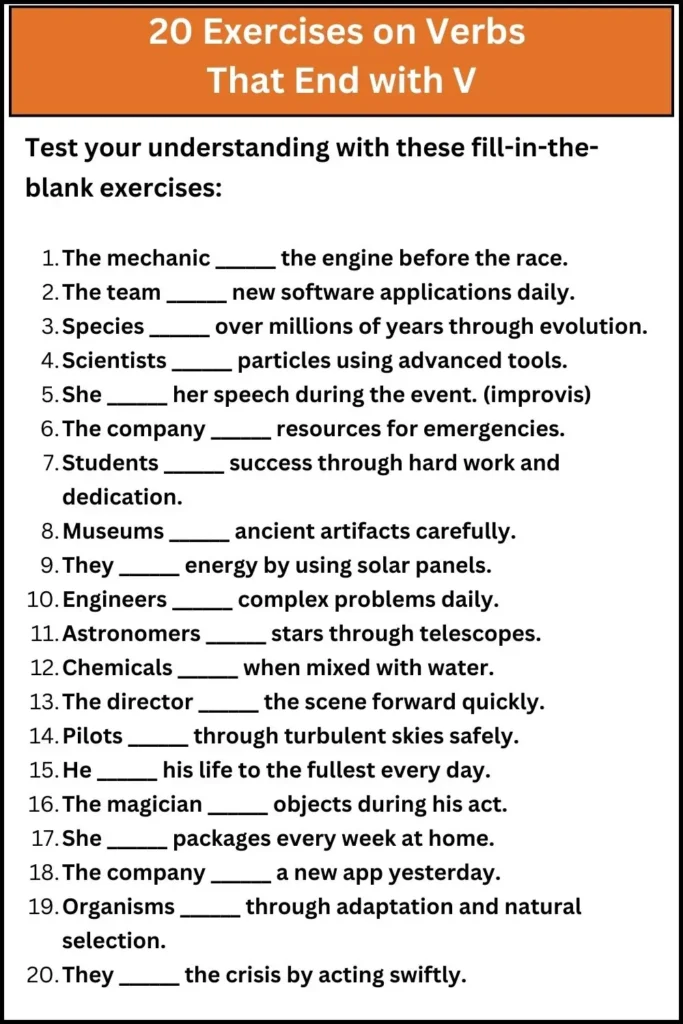
20 Exercises on Verbs That End with V
Test your understanding with these fill-in-the-blank exercises:
The mechanic ______ the engine before the race. (rev)
The team ______ new software applications daily. (dev)
Species ______ over millions of years through evolution. (evolv)
Scientists ______ particles using advanced tools. (grav)
She ______ her speech during the event. (improvis)
The company ______ resources for emergencies. (reserv)
Students ______ success through hard work and dedication. (achiev)
Museums ______ ancient artifacts carefully. (preserv)
They ______ energy by using solar panels. (conserv)
Engineers ______ complex problems daily. (solv)
Astronomers ______ stars through telescopes. (observ)
Chemicals ______ when mixed with water. (dissolv)
The director ______ the scene forward quickly. (mov)
Pilots ______ through turbulent skies safely. (nav)
He ______ his life to the fullest every day. (liv)
The magician ______ objects during his act. (lev)
She ______ packages every week at home. (receiv)
The company ______ a new app yesterday. (devv)
Organisms ______ through adaptation and natural selection. (evolv)
They ______ the crisis by acting swiftly. (avert)
Answers:
revs
dev
evolve
grav
improvises
reserves
achieve
preserve
conserve
solve
observe
dissolve
moves
navigate
lives
levitates
receives
developed
evolve
averted (Note: “avert” does not end with “V,” so this question might be replaced with another verb ending in “V”)
Conclusion on Verbs That End with V
Verbs ending with V may be rare, but they add depth to specialized communication. By understanding their origins, usage, and contextual applications, you can refine your language skills. Whether you’re a student, professional, or language enthusiast, these verbs will help you express ideas with precision. Practice regularly with exercises like those above to reinforce your mastery.