When it comes to expanding your English vocabulary, understanding the subtle patterns of word formation can make all the difference. One fascinating aspect of the language involves Nouns Ending with SH Whether you’re a student learning the basics or an enthusiast delving deeper into linguistics, these nouns not only help you enrich your word bank but also provide insight into how the English language evolves.
In this article, we’ll explore a wide range of nouns that end with “SH,” discuss their meanings, and even uncover some of their unique origins. We’ll also highlight areas where your understanding can grow, filling in the gaps often overlooked by basic word lists. Let’s dive into a topic that promises to enhance both your knowledge and your command of the English language.
What Are Nouns That End with SH?
To begin with, it’s essential to define what exactly a noun is and why the “SH” ending is noteworthy in the world of English grammar.
- Nouns are words that name a person, place, thing, or idea. Examples include “dog,” “city,” and “happiness.”
- A noun that ends with “SH” typically refers to physical objects, actions, or sometimes concepts or states.
Why should we focus on these specific words? Many of them are used frequently in everyday language, and their unique endings can be helpful when forming plural forms or in understanding their linguistic history.
Key Characteristics of Nouns That End with SH
Before we explore a comprehensive list of nouns, let’s first understand the main characteristics that define nouns ending in “SH.” This will help you identify them when you’re reading or speaking English.
- Variety of Meanings: These nouns can represent both physical objects (like “fish”) and abstract concepts (like “crash”).
- Common Usage: Some of these nouns are extremely common in the English language and are integral to everyday conversations.
- Flexible Forms: Many of these nouns can be easily pluralized by adding an “es,” like “brush” to “brushes.”
- Origin Diversity: These words come from a variety of linguistic roots, including Old English, French, and even some African or Indigenous languages.
Identifying Patterns
Looking at the above nouns, we notice a few common threads that make them stand out:
- Common Suffix: The “SH” ending is often linked to words that express actions or physical states (e.g., “crash,” “flush”).
- Nature and Environment: Many of these words relate to animals or natural elements (e.g., “fish,” “angelfish,” “archerfish”).
- Cultural Significance: Certain terms, such as “garnish” and “furnish,” also hold cultural and practical significance in everyday life.
Understanding these patterns can help you identify other nouns that might not appear in a basic list, expanding your vocabulary further.
The Importance of Nouns Ending in SH
While we’ve already explored the basic definition and examples, let’s take a moment to reflect on why it’s important to recognize nouns that end with “SH.”
- Enhancing Communication: Mastery of nouns that end with “SH” helps with clearer communication. Whether you’re describing something in nature or a physical object, these words come in handy.
- Etymology and Word Origins: Many of these nouns trace their origins back to other languages. For example, the word “garnish” comes from Old French, highlighting the blend of cultures that contribute to the English language.
- Learning Grammar Patterns: Recognizing common word endings like “SH” can make it easier to predict the formation of other words, aiding in spelling, pronunciation, and even pluralization.
Expanding Your Vocabulary with Nouns That End with SH
Now that you have a better understanding of how these nouns function, it’s time to explore how you can expand your vocabulary in this area.
- Engage with Literature: Reading books, articles, and stories can help you find more examples of these types of nouns. Pay attention to context and how these words are used.
- Use Flashcards: Create flashcards to help memorize and recall nouns that end with “SH.”
- Practice Writing: Try writing sentences or even short paragraphs using as many of these nouns as possible. This will help reinforce their meanings and usage.
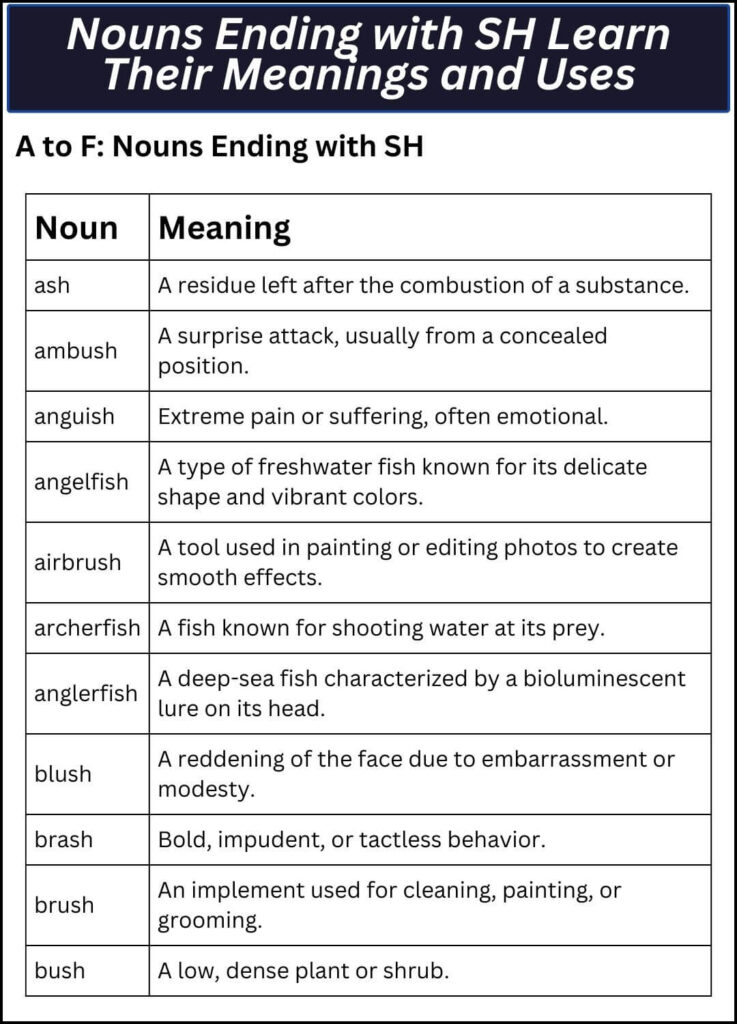
A to F: Nouns Ending with SH
| Noun | Meaning |
|---|---|
| ash | A residue left after the combustion of a substance. |
| ambush | A surprise attack, usually from a concealed position. |
| anguish | Extreme pain or suffering, often emotional. |
| angelfish | A type of freshwater fish known for its delicate shape and vibrant colors. |
| airbrush | A tool used in painting or editing photos to create smooth effects. |
| archerfish | A fish known for shooting water at its prey. |
| anglerfish | A deep-sea fish characterized by a bioluminescent lure on its head. |
| blush | A reddening of the face due to embarrassment or modesty. |
| brash | Bold, impudent, or tactless behavior. |
| brush | An implement used for cleaning, painting, or grooming. |
| bush | A low, dense plant or shrub. |
| bash | To hit something with great force. |

F to J: Nouns Ending with SH
| Noun | Meaning |
|---|---|
| flash | A brief burst of light, or a sudden occurrence of something. |
| flush | To cause to flow or become abundant in a sudden way (e.g., “flush with success”). |
| furnish | To provide or supply with necessary items or equipment. |
| flesh | The soft tissue of the body, especially muscles or skin. |
| fish | A cold-blooded aquatic animal. |
| fresh | New, not spoiled, or recently created. |
| gush | To pour out rapidly and with force, typically in large amounts. |
| garnish | To decorate food with additional items, often for visual appeal. |
| jellyfish | A gelatinous marine animal that drifts with ocean currents. |
| jewfish | A type of fish found in tropical regions, often known for its large size. |
Nouns Ending with SH

Summary Nouns Ending with SH
In this comprehensive guide, we’ve explored a fascinating collection of nouns that end with SH, from A to Z. Whether you’re a student looking to expand your vocabulary, a writer seeking to diversify your language, or simply someone interested in the richness of the English language, this list offers a wide range of interesting and useful terms.
These nouns cover various topics—nature, animals, objects, and abstract concepts—and can be used in different contexts to enhance your communication. By understanding the meanings of these nouns, you can apply them effectively in your writing or everyday conversations.