
In the English language, verbs serve as the core of a sentence, describing actions, occurrences, or states of being. Among the various types of verbs, transitive verbs hold a special place. These verbs require a direct object to complete their meaning and convey a clear, full thought. A sentence with a transitive verb simply doesn’t feel complete without this object.
In this article, we will dive into General Transitive Verbs Starting with BE . By understanding these verbs, you will not only expand your vocabulary but also become more adept at forming meaningful, precise sentences. Whether you are a student learning grammar, a writer seeking variety, or just someone interested in language, this guide will provide the knowledge you need.
What Are Transitive Verbs?
Transitive verbs are action words that require a direct object to complete their meaning. The direct object is the noun or pronoun that receives the action of the verb. These verbs cannot stand alone in a sentence because, without the object, the action remains unclear.
For example:
- She kicked the ball.
- In this case, kicked is the transitive verb, and ball is the direct object. The sentence makes sense because the verb has a clear target (the ball). If we remove the direct object, the sentence “She kicked” becomes incomplete.
To further explain, here’s a breakdown:
- Verb: The action word (e.g., kicked, gave, bought)
- Direct Object: The recipient of the action (e.g., ball, gift, idea)
Transitive verbs are essential in making your communication clear and effective. They provide structure to sentences and ensure that the subject’s action is directed toward something specific. Without a direct object, a transitive verb loses its clarity.
In contrast, intransitive verbs do not require a direct object. For example, in the sentence “She sleeps,” “sleeps” is intransitive because it doesn’t need an object to complete the thought.
Transitive verbs can elevate your writing, adding depth and complexity to your sentences. In the following sections, we will explore a variety of general transitive verbs starting with “BE”, giving you both examples and explanations of their usage.
General Transitive Verbs Starting with BE
Now that we have a solid understanding of what transitive verbs are, let’s dive into a list of general transitive verbs that begin with “BE”. These verbs can help you express actions that target specific objects, making your sentences more complete and meaningful.
1. Definition of Transitive Verbs Starting with BE
These are action verbs that require a direct object and begin with the letters “BE”. They are widely used in both casual and formal writing, adding variety and precision to sentences. Below are examples, along with their definitions and explanations on how they are used.
2. Examples of Transitive Verbs Starting with BE
- Beg: To request earnestly.
- Example: “She begged for mercy.”
- Betray: To be disloyal or reveal something confidential.
- Example: “He betrayed his friend’s trust.”
- Beckon: To signal or call someone to come closer.
- Example: “The waiter beckoned the customer to their table.”
- Bend: To force something into a particular shape.
- Example: “He bent the metal bar into a circle.”
- Befriend: To make friends with someone.
- Example: “She befriended the new student.”
- Bet: To wager money or something valuable.
- Example: “They bet $50 on the game.”
- Belt: To strike forcefully.
- Example: “He belted the ball out of the park.”
- Befoul: To make something dirty or polluted.
- Example: “The river was befouled by industrial waste.”
- Bewilder: To confuse or puzzle someone.
- Example: “The complex puzzle bewildered him.”
- Bend: To shape something by applying force.
- Example: “She bent the paperclip into a heart shape.”
3. Why Are These Verbs Useful?
Understanding and using transitive verbs that start with “BE” enhances your ability to convey specific actions. Each verb on this list carries its own nuance, allowing you to communicate actions clearly and with precision.
These verbs:
- Allow you to convey complex actions that involve an object.
- Help add variety to your writing, making your sentences more dynamic.
- Provide more specific meaning in your conversations and writing.
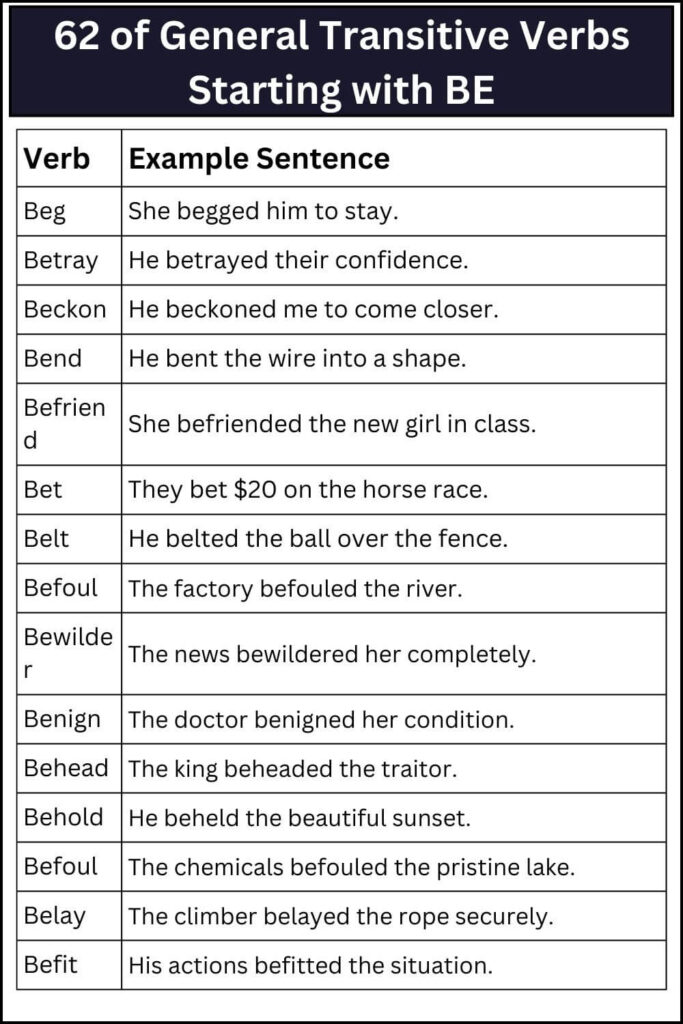
62 of General Transitive Verbs Starting with BE
| # | Verb | Example Sentence |
|---|---|---|
| 1 | Beg | She begged him to stay. |
| 2 | Betray | He betrayed their confidence. |
| 3 | Beckon | He beckoned me to come closer. |
| 4 | Bend | He bent the wire into a shape. |
| 5 | Befriend | She befriended the new girl in class. |
| 6 | Bet | They bet $20 on the horse race. |
| 7 | Belt | He belted the ball over the fence. |
| 8 | Befoul | The factory befouled the river. |
| 9 | Bewilder | The news bewildered her completely. |
| 10 | Benign | The doctor benigned her condition. |
| 11 | Behead | The king beheaded the traitor. |
| 12 | Behold | He beheld the beautiful sunset. |
| 13 | Befoul | The chemicals befouled the pristine lake. |
| 14 | Belay | The climber belayed the rope securely. |
| 15 | Befit | His actions befitted the situation. |
| 16 | Beget | The king begot many heirs. |
| 17 | Bequeath | She bequeathed her estate to charity. |
| 18 | Betrayal | His actions betrayed their trust. |
| 19 | Bewitch | The magician bewitched the crowd. |
| 20 | Belch | He belched loudly after the meal. |
| 21 | Beleaguer | The soldiers beleaguered the fortress. |
| 22 | Behoove | It behooves us to help those in need. |
| 23 | Befoul | The waste befouled the beach. |
| 24 | Belie | His actions belied his true intentions. |
| 25 | Behead | The executioner beheaded the criminal. |
| 26 | Belong | The book belongs to the library. |
| 27 | Bequeath | The old man bequeathed all his possessions. |
| 28 | Believe | She believes in fairytales. |
| 29 | Behave | The children behaved during the ceremony. |
| 30 | Beholden | He was beholden to his mentor for advice. |
| 31 | Befoul | The industry befouled the river with pollutants. |
| 32 | Befriend | She befriended the shy student. |
| 33 | Betide | May fortune betide you on your journey. |
| 34 | Behead | They beheaded the traitor to demonstrate power. |
| 35 | Behold | He stood still, beholding the masterpiece. |
| 36 | Bespeak | The stains bespoke years of neglect. |
| 37 | Benign | His words benigned her fears. |
| 38 | Belong | This notebook belongs to me. |
| 39 | Behead | The knight beheaded the dragon. |
| 40 | Befit | His attire befitted the royal court. |
| 41 | Belie | His smile belied his true feelings. |
| 42 | Bequeath | He bequeathed his fortune to his family. |
| 43 | Betray | The spy betrayed the mission. |
| 44 | Behead | The executioner beheaded the guilty man. |
| 45 | Behold | He paused to behold the beauty of the mountain. |
| 46 | Bewitch | Her charm bewitched the crowd. |
| 47 | Beholden | She felt beholden to her benefactor. |
| 48 | Beleaguer | The enemy beleaguered the castle. |
| 49 | Beget | His success will beget more opportunities. |
| 50 | Betrayal | His betrayal left them heartbroken. |
| 51 | Beleaguer | The army beleaguered the village for days. |
| 52 | Bet | She bet everything on the winning team. |
| 53 | Behold | We beheld the magnificent view of the city. |
| 54 | Behave | You must behave during the ceremony. |
| 55 | Benign | His actions were benign and harmless. |
| 56 | Bequeath | She bequeathed her fortune to charity. |
| 57 | Befriend | He befriended the new student immediately. |
| 58 | Betide | May happiness betide you soon. |
| 59 | Bespeak | The crack in the wall bespoke years of neglect. |
| 60 | Belie | His smooth talk belied his true nature. |
| 61 | Behead | They beheaded the accused after the trial. |
| 62 | Behold | He beheld the beauty of the setting sun. |

FAQs on General Transitive Verbs Starting with BE
What is a transitive verb? A transitive verb is an action verb that requires a direct object to complete its meaning. The action is done to someone or something.
Why is it important to learn transitive verbs that start with BE? These verbs allow you to express complex actions and situations. By using them, you can diversify your language and communicate more precisely.
Can a verb start with BE and still be intransitive? Yes, some verbs that start with BE can be intransitive. For example, “be” in “She is happy” does not take a direct object, so it’s intransitive in this case.
How can I practice using these verbs? Try incorporating them into your daily conversations or writing. For example, challenge yourself to write a sentence for each verb, focusing on clarity and proper object usage.
Conclusion on General Transitive Verbs Starting with BE
Mastering transitive verbs starting with BE can significantly improve the way you express yourself in English. They offer precision and clarity, helping to convey specific actions that target distinct objects. By incorporating these verbs into your vocabulary, you’ll enhance both your writing and speaking skills.
Use the list above to explore and practice these verbs, and don’t forget to refer back to the examples to understand their application better. With consistent practice, you’ll become more fluent and confident in using transitive verbs effectively.
