
David Wilkins, a renowned British linguist, once said, “Without grammar, very little can be conveyed, but without vocabulary, nothing can be conveyed.” This quote underlines a fundamental truth: while grammar is essential, it’s your vocabulary that empowers you to communicate with precision, depth, and clarity.
In today’s article, we’ll not only explore why expanding your vocabulary is important but also introduce you to 30+ Advance english words that can make you sound more articulate, confident, and persuasive. Whether you’re a student aiming for higher exam scores, a professional improving your communication, or just someone keen on learning new words, this guide is for you.
Why Should You Learn Advanced English Vocabulary?
Mastering advanced vocabulary gives you the ability to express complex ideas with more accuracy. Imagine telling someone you’re “happy” versus telling them you are “elated” — both are correct, but the latter paints a more vivid picture of your emotions. This ability to add depth and color to your communication is what sets advanced speakers apart.
Here’s how learning advanced vocabulary can benefit you:
Boost Confidence: Using sophisticated words gives you the power to express nuanced thoughts and engage in high-level conversations.
Read Complex Materials with Ease: You’ll gain the ability to comprehend a wider range of texts, from academic papers to advanced literature.
Improve Writing Quality: Advanced words bring precision to your writing, helping you convey your ideas with clarity and sophistication.
Increase Exam Scores: For exams like TOEFL, IELTS, and Cambridge Proficiency, mastering advanced vocabulary can make a difference in your performance.
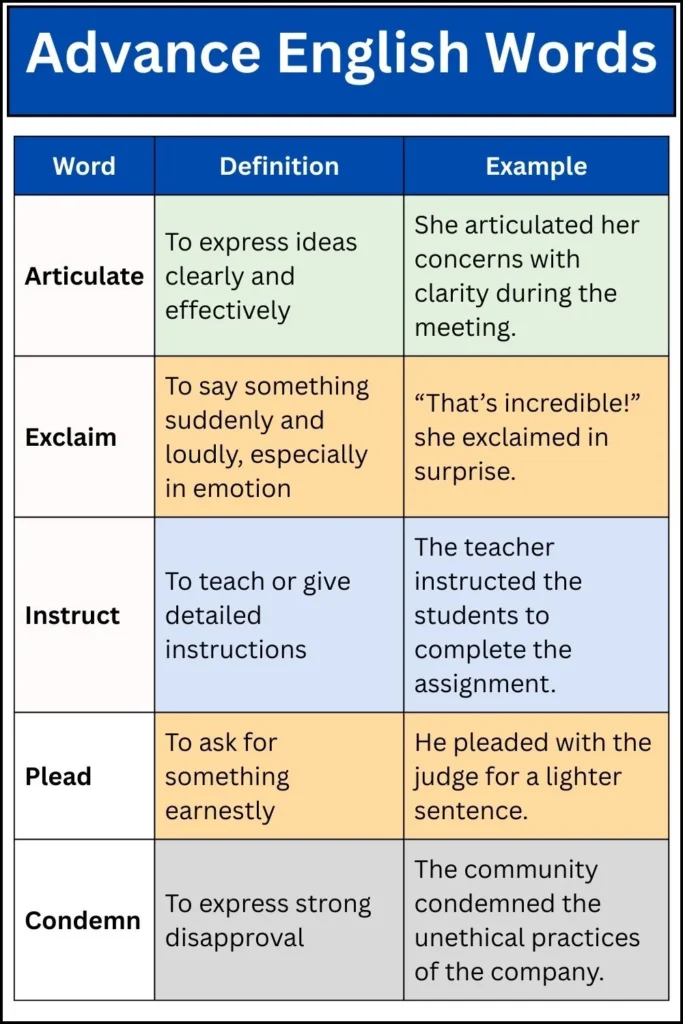
30+ Advanced English Vocabulary Words You Can Use in Daily Life
Let’s dive into the list of 60 advanced words, grouped into categories that are essential for a variety of contexts.
1. Words for Communication
| Word | Definition | Example |
|---|---|---|
| Articulate | To express ideas clearly and effectively | She articulated her concerns with clarity during the meeting. |
| Exclaim | To say something suddenly and loudly, especially in emotion | “That’s incredible!” she exclaimed in surprise. |
| Instruct | To teach or give detailed instructions | The teacher instructed the students to complete the assignment. |
| Plead | To ask for something earnestly | He pleaded with the judge for a lighter sentence. |
| Condemn | To express strong disapproval | The community condemned the unethical practices of the company. |
2. Words for Describing Relationships
| Word | Definition | Example |
|---|---|---|
| Bond | To develop a strong relationship | They bonded over their shared love for art. |
| Click | To form an immediate and strong connection | We clicked as soon as we started talking. |
| Spouse | A husband or wife | She lost her spouse in a tragic accident. |
| Rocky | A relationship that is unstable or in trouble | Their marriage went through a rocky phase, but they worked it out. |
3. Words for Describing People and Personalities
| Word | Definition | Example |
|---|---|---|
| Eccentric | Unconventional and slightly strange | His eccentric behavior made him a beloved character in the community. |
| Resourceful | Able to find quick and clever solutions to problems | She’s resourceful enough to fix almost anything that breaks. |
| Cynical | Believing that people are motivated by self-interest | The politician’s cynical remarks left many voters disillusioned. |
4. Words for Describing Things
| Word | Definition | Example |
|---|---|---|
| Shabby | Worn out or in poor condition | The house looked shabby after years of neglect. |
| Defective | Imperfect, flawed, or not working properly | The appliance was defective, so we returned it. |
| Sensational | Extremely exciting or excellent | The movie received sensational reviews from critics. |
5. Words for Actions
| Word | Definition | Example |
|---|---|---|
| Grin | To smile broadly | He grinned from ear to ear when he received the good news. |
| Stamp | To strike the ground with force | She stamped her foot in frustration after hearing the news. |
| Sprinkle | To scatter or scatter lightly | Sprinkle the topping evenly over the cake before serving. |
How to Learn and Master Advanced Vocabulary
Learning new vocabulary isn’t just about memorizing words. To truly internalize them, consider the following strategies:
Contextual Learning: Read books, articles, and listen to podcasts or watch movies where these words are used naturally. This will help you understand their usage and nuances.
Use a Vocabulary Journal: Write down new words, their definitions, and example sentences. Review them regularly to reinforce your memory.
Practice Speaking: Use new words in your daily conversations or when practicing speeches. The more you use them, the more confident you’ll become.
Learn Synonyms: For every advanced word, find a few synonyms. This will increase your flexibility in language use.
FAQs On Advance english words
What are some Advance english words ?
Some advanced English words include ubiquitous, quintessential, effervescent, perspicacious, melancholy, ephemeral, serendipity, capricious, epiphany, and soliloquy. These words are typically used in more formal or literary contexts to add depth and precision to communication.
What are 10 tricky words with meaning?
Bamboozle – To deceive or confuse someone.
Cacophony – A harsh, discordant mixture of sounds.
Defenestration – The act of throwing someone out of a window.
Discombobulate – To confuse or disconcert.
Ephemeral – Lasting for a very short time.
Intransigent – Unwilling to change one’s views or opinions.
Lugubrious – Looking or sounding sad and dismal.
Pernicious – Having a harmful effect, especially in a gradual or subtle way.
Quixotic – Extremely idealistic, unrealistic, and impractical.
Sycophant – A person who acts obsequiously towards someone important to gain advantage.
What are some rich vocabulary words?
Some rich vocabulary words include magnanimous, perceptive, sagacious, magnificent, benevolent, effulgent, resplendent, loquacious, adroit, and incandescent. These words can elevate speech and writing by adding depth, complexity, and precision.
What are 10 unfamiliar words?
Agog – Very eager or curious to hear or see something.
Anachronistic – Belonging to a time other than the one in which it exists.
Bifurcate – To divide into two parts.
Dyspeptic – Having indigestion or a bad-tempered disposition.
Ebullient – Enthusiastic or bubbling with energy.
Fecund – Capable of producing an abundance of offspring or new growth.
Pusillanimous – Lacking courage or determination.
Querulous – Complaining in a petulant or whining manner.
Sesquipedalian – (of a word) Long and ponderous; characterized by long words.
Zephyr – A gentle, mild breeze.
Conclusion on Advance english words
Expanding your vocabulary with Advance english words is a game-changer for both written and spoken communication. By mastering words like ephemeral, perspicacious, and quixotic, you’ll be able to express yourself more precisely and impressively. Whether you’re writing an essay, preparing for an exam, or engaging in a professional conversation, using Advance english words can elevate your communication skills and give you an edge. The key is to practice regularly and incorporate these words naturally into your daily conversations.
By doing so, you’ll develop a deeper understanding of the language, making your speech and writing richer and more impactful. Keep challenging yourself, and soon you’ll find that using advanced vocabulary becomes second nature, setting you apart as a confident and articulate communicator.
