

English is a global language spoken across diverse cultures, countries, and professions. While it’s incredibly useful in everyday life, it can also present challenges—especially when it comes to grammar. Whether you’re learning English as a second language or simply aiming to improve your skills, it’s easy to make grammatical mistakes. Some are minor and go unnoticed, but others can lead to confusion or miscommunication.
In this article, we will explore common grammatical errors in English and provide practical tips on how to fix them. By understanding these common pitfalls, you’ll be better equipped to write and speak more confidently, avoiding confusion in both personal and professional contexts.
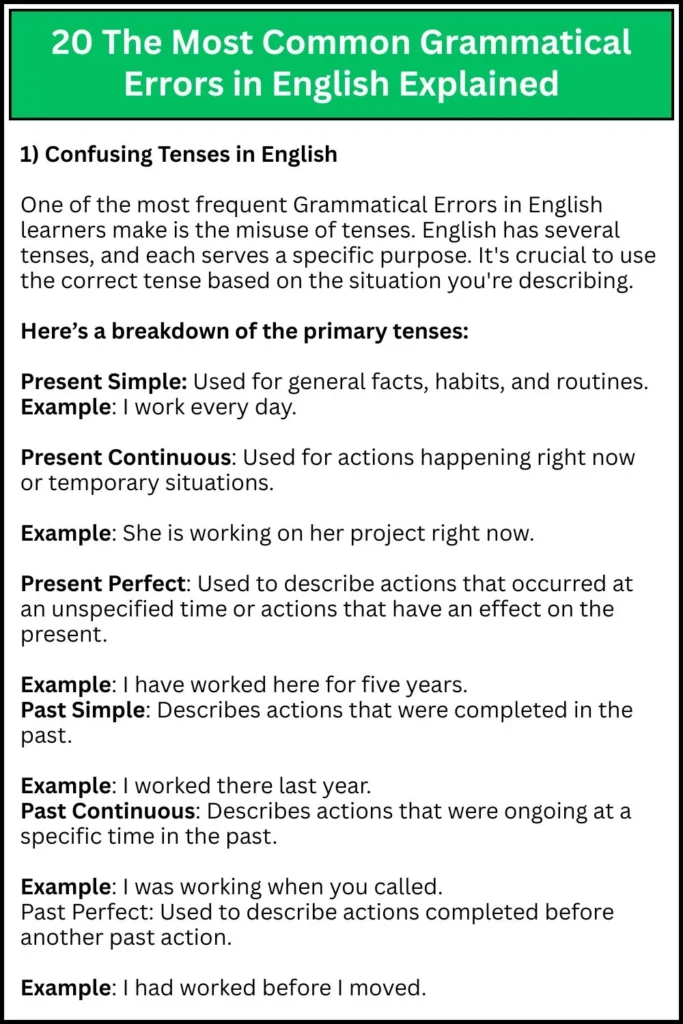

1) Confusing Tenses in English
One of the most frequent Grammatical Errors in English learners make is the misuse of tenses. English has several tenses, and each serves a specific purpose. It’s crucial to use the correct tense based on the situation you’re describing. Here’s a breakdown of the primary tenses:
Present Simple: Used for general facts, habits, and routines.
Example: I work every day.
Present Continuous: Used for actions happening right now or temporary situations.
Example: She is working on her project right now.
Present Perfect: Used to describe actions that occurred at an unspecified time or actions that have an effect on the present.
Example: I have worked here for five years.
Past Simple: Describes actions that were completed in the past.
Example: I worked there last year.
Past Continuous: Describes actions that were ongoing at a specific time in the past.
Example: I was working when you called.
Past Perfect: Used to describe actions completed before another past action.
Example: I had worked before I moved.
2) Misusing Adverbs and Adjectives
Another frequent mistake is the incorrect use of adverbs and adjectives. While both adverbs and adjectives describe things, they have different roles in a sentence. Adjectives modify nouns, while adverbs modify verbs, adjectives, or other adverbs. For example:
-
Incorrect: She sings beautiful. (Adjective used instead of adverb)
-
Correct: She sings beautifully. (Adverb modifies the verb “sings”)
3) Your vs. You’re: A Common Pitfall
The confusion between “your” and “you’re” is one of the most common mistakes in English. These words are pronounced the same but have different meanings:
-
Your is a possessive pronoun. It shows ownership.
Example: Is this your book? -
You’re is a contraction of “you are.”
Example: You’re going to love this movie.
The confusion usually arises when people try to use “your” when they should be using “you’re.” A quick trick to remember is to see if you can replace the word with “you are.” If you can, then “you’re” is correct. If not, then “your” is the right choice.
4) Misplacing Apostrophes
Apostrophes are another tricky aspect of English grammar, especially when it comes to possession. Many learners confuse the rules for pluralization and possession. Here’s how to use apostrophes correctly:
-
For singular possession, place the apostrophe before the “s.”
Example: The boy’s toy. -
For plural possession, place the apostrophe after the “s.”
Example: The girls’ books. -
For contractions, apostrophes replace missing letters.
Example: Can’t (Cannot), It’s (It is).
A common mistake is to use an apostrophe to make a word plural. For instance, “apple’s” should not be used to mean more than one apple.
5) There, Their, and They’re
These three words sound the same but are used in different contexts, and misusing them is a frequent mistake. Let’s break down their usage:
-
There refers to a place or location.
Example: Put the book over there. -
Their shows possession.
Example: Their car is parked outside. -
They’re is a contraction for “they are.”
Example: They’re going to the store later.
The key is to pay attention to what you’re trying to express—location, possession, or a contraction of “they are.” It’s easy to make mistakes here, but with a little practice, you’ll get the hang of it.
6) The “Two,” “Too,” and “To” Mix-Up
In English, “two,” “too,” and “to” are homophones, which means they sound the same but have different meanings. Here’s how to use each:
-
Two is a number.
Example: I have two brothers. -
Too means “also” or “excessively.”
Example: I want to go too.
Example: The coffee is too hot. -
To is a preposition or part of an infinitive verb.
Example: I’m going to the store.
Example: I want to eat pizza.
When writing, be sure to double-check whether you mean the number “two,” an addition or excess “too,” or the preposition “to.”
7) Incomplete Comparisons
Making incomplete comparisons is a common mistake in English. A comparison helps to measure or highlight the differences between two things, but it’s easy to miss the second element, making the sentence grammatically incorrect. Here’s an example of an incomplete comparison:
-
Incorrect: The car is faster.
-
Correct: The car is faster than the truck.
In the incorrect sentence, we don’t know what the car is being compared to. Adding “than” and completing the comparison with “the truck” clarifies the meaning.
To fix incomplete comparisons, always ensure you have both elements being compared, and make sure the structure of the sentence reflects this clearly.
8) Mixing Up Adjectives and Adverbs
Another frequent error occurs when learners confuse adjectives and adverbs. While both can modify words, they serve different functions:
-
Adjectives describe or modify nouns (people, places, or things).
-
Adverbs describe or modify verbs, adjectives, or other adverbs.
For example:
-
Incorrect: She is a quick runner. (Quick is an adverb modifying a noun, which is incorrect)
-
Correct: She is a quick runner. (Quick modifies the noun ‘runner,’ so it’s an adjective.)
Similarly, in the sentence:
-
Incorrect: I feel real tired. (Real is an adjective modifying a verb)
-
Correct: I feel really tired. (Really is an adverb modifying the adjective tired)
Always remember that if you are describing a noun, you use an adjective. If you are modifying a verb or another adjective, you use an adverb.
9) Misplaced Modifiers
Modifiers add descriptive elements to your sentences, but when placed incorrectly, they can cause confusion and alter the intended meaning. A misplaced modifier is one that is positioned too far from the word it is meant to describe. Here’s an example of a misplaced modifier:
-
Incorrect: He almost drove for the entire day.
-
Correct: He drove for almost the entire day.
In the incorrect example, it is unclear whether he almost drove for the entire day or if he drove the entire day. The corrected sentence clarifies that he drove the entire day but not quite the full 24 hours.
To fix misplaced modifiers, ensure they are placed as close as possible to the word they modify. This way, the meaning of the sentence remains clear.
10) Pronoun Agreement Errors
Pronoun agreement refers to the correspondence between pronouns and the nouns they replace. One common mistake is failing to match the number (singular or plural) of the pronoun with the noun it refers to. For instance:
-
Incorrect: Each of the boys must sign their name. (The noun “each” is singular, so “their” should be “his.”)
-
Correct: Each of the boys must sign his name.
To avoid pronoun agreement errors, always check that your pronouns match the number and gender of the nouns they refer to. If you’re talking about a singular subject, use singular pronouns; if you’re talking about a plural subject, use plural pronouns.
11) Confusing “Fewer” and “Less”
One of the more subtle mistakes in English involves the proper use of “fewer” and “less.” These two words are often misused, even by native speakers. The rule is simple:
-
Fewer is used when referring to countable nouns (things you can count).
Example: I have fewer books than you. -
Less is used for uncountable nouns (things that can’t be counted individually).
Example: I have less water than you.
A quick tip is to remember that if you can add a number in front of the noun, use “fewer.” If you cannot count the noun, use “less.”
12) Using Double Negatives
In English, two negatives typically make a positive, which can lead to confusion if used incorrectly. Double negatives can make a sentence sound awkward or incorrect. For example:
-
Incorrect: I don’t need no help.
-
Correct: I don’t need any help.
The phrase “don’t need no help” contains a double negative (don’t + no), which leads to confusion. To avoid this, stick with just one negative form: “I don’t need any help.”
13) Subject-Verb Agreement Errors
Subject-verb agreement is a crucial aspect of grammar that ensures the subject and verb in a sentence match in number (singular or plural). Here’s an example:
-
Incorrect: The team are playing well.
-
Correct: The team is playing well.
In the first sentence, “team” is singular, so the verb should also be singular (“is” instead of “are”). The key is to ensure that your subject and verb agree in number. Pay special attention when the subject seems plural (e.g., “team,” “family,” “group”) but is actually treated as singular in certain contexts.
14) Avoiding Redundancy
Redundancy occurs when words or phrases repeat the same idea, leading to unnecessary repetition. For example:
-
Incorrect: I’m going to the store to buy new clothes, because I need new clothes.
-
Correct: I’m going to the store to buy new clothes.
In the incorrect sentence, “new clothes” is repeated unnecessarily. Avoid redundancy by cutting out repeated information unless it adds value to your sentence.
15) The Importance of Punctuation
Punctuation marks in English are essential for clarifying meaning. Without them, sentences can become confusing or change their intended message entirely. Here are some of the most commonly misused punctuation marks:
-
Commas: Commas separate items in a list, clauses, or parts of a sentence, and can prevent confusion.
Example: Let’s eat, Grandma. (Without the comma, it reads as if you’re telling Grandma to eat, rather than inviting her to dinner.) -
Apostrophes: As mentioned earlier, apostrophes show possession or indicate contractions.
Example: The dog’s bone (possession), She’s going to the store (contraction for “she is”). -
Quotation Marks: Quotation marks enclose direct speech or citations. Incorrect usage can make it unclear who is speaking or what is being cited.
Example: “I am happy,” she said. (Direct speech requires quotation marks to clearly mark the spoken words.) -
Colons and Semicolons: Both marks are used to link closely related ideas, but they have distinct uses.
Example: I need the following items: apples, bananas, and grapes. (Colon for lists)
Example: I love apples; she prefers bananas. (Semicolon for connecting two independent clauses)
Punctuation is the framework that holds your sentences together. Without proper punctuation, your message can become unclear or even change entirely.
16) Using “Between” vs. “Among”
Confusion between “between” and “among” is common, but the rules are simple:
-
Between is used when referring to two things.
Example: The ball is between the two players. -
Among is used when referring to three or more things.
Example: The ball is among the five players.
By keeping these distinctions in mind, you can avoid errors that sound unnatural and awkward in English.
17) The Use of “Less” and “Fewer” with Time and Money
As mentioned earlier, “less” and “fewer” are often confused. However, it’s important to consider how these terms apply to time, money, and other measurements. The rule is:
-
Less is used for uncountable nouns, including time and money.
Example: I have less money than you.
Example: There is less time to finish the project. -
Fewer is used for countable nouns.
Example: I have fewer tasks to complete today.
18) Double Comparisons
In some cases, learners use double comparatives, which are incorrect. A double comparative is when you combine two comparative forms of an adjective in one sentence. Here’s an example:
-
Incorrect: She is more smarter than him.
-
Correct: She is smarter than him.
In the incorrect sentence, “more smarter” is redundant. You only need one comparative form, “smarter,” to make the comparison.
Always ensure you use only one form of comparison in each sentence.
19) Mixing Up “Who” and “Whom”
“Who” and “whom” are two words that often cause confusion, particularly in formal writing. Here’s how to use them:
-
Who is used as the subject of a sentence (it performs the action).
Example: Who is going to the party? -
Whom is used as the object of a sentence (it receives the action).
Example: To whom should I address the letter?
A simple trick to remember: If you can replace the word with “he” or “she,” use “who.” If you can replace it with “him” or “her,” use “whom.”
20) Overusing the Passive Voice
While the passive voice is an important aspect of English grammar, overusing it can make your writing sound awkward and indirect. In the passive voice, the subject of the sentence receives the action rather than performing it. Here’s an example:
-
Passive: The book was read by the student.
-
Active: The student read the book.
Using the active voice is usually more straightforward and engaging. However, the passive voice is useful when you want to emphasize the action or the recipient of the action, rather than the doer.
Conclusion On Grammatical Errors in English
Understanding and avoiding grammatical errors in English is essential for effective communication. By familiarizing yourself with common mistakes and their corrections, you can significantly improve your writing and speaking skills.
Always pay attention to your verb tenses, word choices, sentence structure, and punctuation. Whether you are writing an email, giving a presentation, or having a conversation, good grammar builds confidence and helps you express your ideas clearly.
As you continue to practice, these grammatical rules will become second nature, and your English skills will improve significantly. Embrace the learning process and remember, even native speakers make mistakes from time to time. The key is to learn from them and keep practicing!