

IELTS Writing Task 2 is one of the most crucial components of the IELTS exam. Whether you’re taking the Academic or General Training test, your ability to express clear, coherent ideas through written English plays a central role in your overall score. This task is designed to assess not only your language proficiency but also your critical thinking skills, the ability to organize your ideas, and your capacity to present arguments effectively.
This article will cover everything you need to know about IELTS Writing Task 2, from the types of essays you might encounter to the specific strategies you can use to ensure that your writing stands out.
What is IELTS Writing Task 2?
In IELTS Writing Task 2, you are required to write an essay based on a given prompt. The essay should be at least 250 words long and needs to be completed within 40 minutes. Unlike Task 1, which is focused on describing data or a visual representation, Task 2 involves presenting and developing an argument. You’ll be assessed on your ability to address the question, present a clear argument, and provide supporting evidence in an organized manner.
Key aspects of IELTS Writing Task 2:
- You need to write a formal essay.
- Your essay should be coherent and well-structured.
- You will be assessed on task response, coherence, vocabulary, and grammar.
Types of IELTS Writing Task 2 Essays
IELTS Writing Task 2 covers a variety of essay types. Understanding each type will help you prepare effectively and choose the best strategy to tackle the task. Here’s an overview of the most common essay types:
Opinion Essay
In an opinion essay, you are asked to state your opinion on a particular issue and justify it with supporting reasons and examples. This is one of the most common types of essays, and it tests your ability to argue effectively.
Discussion Essay
A discussion essay requires you to discuss both sides of an issue and give your own opinion. You need to present arguments for both perspectives and then choose which one you agree with.
Advantages and Disadvantages Essay
For an advantages and disadvantages essay, you are required to explore the pros and cons of a particular issue. This type of essay evaluates your ability to objectively present the positive and negative aspects of a topic.
Problem and Solution Essay
In a problem and solution essay, you must identify a problem, explain its causes and effects, and then suggest practical solutions. This essay type tests your problem-solving skills and ability to provide well-reasoned solutions.
Direct Question Essay
The direct question essay involves answering one or more questions related to a particular topic. It could involve explaining causes and effects or discussing potential solutions to a problem.
Elements to Structure Your Essay
When tackling IELTS Writing Task 2, your essay must be well organized and clear. Each essay should include an introduction, body paragraphs, and a conclusion. Here’s how you can structure your essay for maximum impact:
Introduction
- Paraphrase the question to show that you understand the prompt.
- State your opinion clearly if the task asks for one, or present both sides if it’s a discussion or advantages/disadvantages essay.
Body Paragraphs
- Each paragraph should present a single idea or argument.
- Start with a topic sentence that clearly introduces the idea.
- Support your points with relevant examples or explanations.
Conclusion
- Summarize the main points of your essay.
- Restate your opinion or provide a final thought if the essay type requires it.
Scoring Criteria for IELTS Writing Task 2
To achieve a high band score in IELTS Writing Task 2, it is essential to understand the marking criteria. Your essay will be graded based on the following four key factors:
-
Task Response (25%)
This criterion evaluates how well you address the prompt. Do you fully answer the question? Are your arguments relevant and well-supported? -
Coherence and Cohesion (25%)
The examiner looks for logical organization and clear paragraphing. Effective use of linking words, transitions, and proper paragraphing ensures your essay flows smoothly. -
Lexical Resource (25%)
This assesses your vocabulary. Are you using a variety of words appropriately? Are your collocations, idioms, and word forms accurate and varied? -
Grammatical Range and Accuracy (25%)
Your grammar is evaluated based on the accuracy and complexity of your sentence structures. Do you use a mix of simple and complex sentences? Are there any errors in punctuation or sentence structure?
Strategies to Improve Your IELTS Writing Task 2 Score
Achieving a high score in IELTS Writing Task 2 requires more than just understanding the format. It involves practice, planning, and a strategic approach to writing. Here are some tips to help you succeed:
Understand the Question
Before you start writing, make sure you fully understand the question. Look for keywords and decide what type of essay you need to write. Take a few minutes to brainstorm ideas and organize them before you begin.
Plan Your Essay
Spend a few minutes planning your essay structure. For opinion and discussion essays, ensure that each paragraph presents one clear argument. For advantages and disadvantages essays, organize your thoughts before writing.
Use Relevant Examples
Your arguments should be supported by examples. These examples could be drawn from personal experience, historical events, or general knowledge. They make your essay more convincing and demonstrate your ability to think critically.
Keep It Clear and Simple
While it’s important to showcase your vocabulary and grammar, avoid overcomplicating your writing. Stick to clear, concise sentences and avoid excessive jargon. A well-structured essay with straightforward language will always score better than a convoluted one.
Practice Time Management
You have 40 minutes to write your essay, so time management is crucial. Spend 5 minutes planning, 30 minutes writing, and 5 minutes reviewing and editing your work.
Common Mistakes to Avoid in IELTS Writing Task 2
While writing your essay, be mindful of the following common mistakes that can lower your score:
Not Answering the Question Fully
Always address all parts of the prompt. If it’s a question that asks for an opinion, make sure you provide your opinion clearly. If it’s a discussion essay, ensure you present both views before giving your own opinion.
Lack of Clear Structure
Ensure that each paragraph flows logically into the next. Use linking words and clear transitions to connect ideas, and make sure you stay within the proper paragraphing format.
Repetition of Words and Phrases
Avoid using the same words or phrases repeatedly. This can make your writing sound monotonous. Instead, vary your vocabulary and use synonyms when appropriate.
Grammar and Spelling Errors
Check your essay for grammatical and spelling errors. A few mistakes are inevitable, but frequent errors can significantly impact your score, especially in the Grammatical Range and Accuracy criterion.
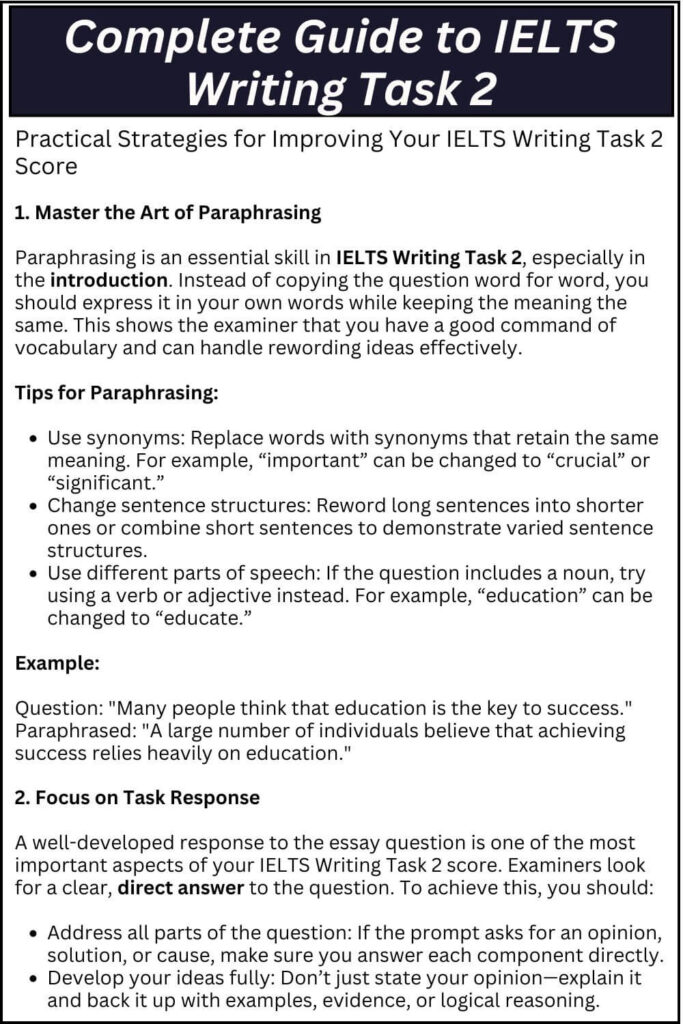

Practical Strategies for Improving Your IELTS Writing Task 2 Score
Improving your score in IELTS Writing Task 2 involves consistent practice and the application of specific strategies. With the right techniques, you can boost your band score and feel more confident about writing high-scoring essays. Below are some effective strategies that will help you perform better in this crucial part of the exam.
1. Master the Art of Paraphrasing
Paraphrasing is an essential skill in IELTS Writing Task 2, especially in the introduction. Instead of copying the question word for word, you should express it in your own words while keeping the meaning the same. This shows the examiner that you have a good command of vocabulary and can handle rewording ideas effectively.
Tips for Paraphrasing:
- Use synonyms: Replace words with synonyms that retain the same meaning. For example, “important” can be changed to “crucial” or “significant.”
- Change sentence structures: Reword long sentences into shorter ones or combine short sentences to demonstrate varied sentence structures.
- Use different parts of speech: If the question includes a noun, try using a verb or adjective instead. For example, “education” can be changed to “educate.”
Example:
Question: “Many people think that education is the key to success.”
Paraphrased: “A large number of individuals believe that achieving success relies heavily on education.”
2. Focus on Task Response
A well-developed response to the essay question is one of the most important aspects of your IELTS Writing Task 2 score. Examiners look for a clear, direct answer to the question. To achieve this, you should:
- Address all parts of the question: If the prompt asks for an opinion, solution, or cause, make sure you answer each component directly.
- Develop your ideas fully: Don’t just state your opinion—explain it and back it up with examples, evidence, or logical reasoning.
- Stay on topic: Avoid diverging from the question and introducing irrelevant information.
Example:
If the question asks, “What are the causes of air pollution and how can we solve this problem?” ensure that you discuss both the causes and the solutions thoroughly in your essay.
3. Use a Variety of Sentence Structures
Examiners reward essays that demonstrate a wide range of grammatical structures. By using both simple and complex sentences, you can show that you are capable of expressing yourself in a varied and sophisticated way.
Sentence Structure Tips:
- Use compound sentences (e.g., “Air pollution is harmful to the environment, and it contributes to climate change”).
- Incorporate complex sentences with subordinate clauses (e.g., “Although air pollution has many causes, industrial emissions remain the most significant”).
- Use different sentence beginnings to avoid repetition (e.g., start some sentences with adverbs, conditionals, or conjunctions).
Example:
Simple sentence: “Air pollution is a serious issue.”
Complex sentence: “Although air pollution is a growing problem, it can be reduced with effective government policies.”
4. Link Your Ideas with Coherent Transitions
Coherence and cohesion are essential for writing a well-organized essay. The logical flow of ideas and smooth transitions between paragraphs will help your argument appear clearer and more structured. Use linking words to guide the reader through your essay.
Useful Linking Words for Coherence:
- For adding information: Furthermore, In addition, Moreover
- For contrast: However, On the other hand, Although
- For cause and effect: Therefore, As a result, Because of this
- For examples: For example, Such as, In particular
Example:
- Coherent paragraph:
“Air pollution has many causes. Industrial activity is a significant contributor to the problem. However, deforestation also plays a major role. The loss of trees leads to a decrease in oxygen levels, further exacerbating air quality.”
5. Develop Your Vocabulary
A rich vocabulary can significantly improve the quality of your essay. Instead of repeating the same words, make use of synonyms and more specific terms that precisely describe your ideas. This will also improve your lexical resource score.
Vocabulary Tips:
- Use academic language: Incorporate words that are formal and suitable for academic writing. For example, use “significant” instead of “big” or “crucial” instead of “important.”
- Avoid overly simple words: While simple language is important for clarity, using a variety of vocabulary shows that you have a better grasp of the language.
- Practice collocations: These are word combinations that often go together in English (e.g., “solve a problem,” “face challenges”).
Example:
Instead of writing “there are many problems with the environment,” try:
“The environment faces a number of pressing challenges, including deforestation and pollution.”
6. Proofread Your Essay
At the end of the 40 minutes, you should reserve at least 5 minutes to proofread your essay. This final check will help you catch any grammar mistakes, spelling errors, or typos that could lower your score. It’s also a good time to ensure that your sentences flow well and that you have answered the question fully.
Proofreading Checklist:
- Check spelling and grammar: Ensure all words are spelled correctly, and sentence structures are grammatically correct.
- Look for word repetition: Avoid repeating words or phrases too often.
- Ensure clarity: Read your essay aloud to see if it flows naturally.
7. Practice, Practice, Practice
The best way to improve your IELTS Writing Task 2 skills is through consistent practice. Write essays on various topics and seek feedback. The more you practice, the more confident and efficient you will become.
Practice Tips:
- Set a timer for 40 minutes to replicate exam conditions.
- Write essays on a variety of topics: education, technology, health, the environment, etc.
- Seek feedback: Have someone review your essays and provide constructive feedback.
FAQs On IELTS Writing Task 2
1. What is IELTS Writing Task 2?
IELTS Writing Task 2 is an essay-writing section where you need to write a formal essay based on a given prompt. The task evaluates your ability to present and support arguments, as well as your language proficiency. The essay must be at least 250 words and completed within 40 minutes.
2. What are the different types of essays in IELTS Writing Task 2?
There are several types of essays in IELTS Writing Task 2, including:
- Opinion Essay: State your opinion on a topic and justify it.
- Discussion Essay: Discuss both sides of an issue and give your opinion.
- Advantages and Disadvantages Essay: Explore the pros and cons of a topic.
- Problem and Solution Essay: Identify a problem, explain its causes, and propose solutions.
- Direct Question Essay: Answer one or more questions related to a topic.
3. How is IELTS Writing Task 2 scored?
IELTS Writing Task 2 is scored based on four criteria, each contributing 25% to the final score:
- Task Response: How well you answer the question.
- Coherence and Cohesion: Logical flow and organization of ideas.
- Lexical Resource: Vocabulary usage and variety.
- Grammatical Range and Accuracy: Sentence structures and grammar usage.
4. What are some strategies for improving my IELTS Writing Task 2 score?
To improve your score, focus on:
- Planning your essay before writing.
- Using a clear structure: Introduction, body paragraphs, and conclusion.
- Supporting your ideas with relevant examples.
- Varying your vocabulary and sentence structures.
- Proofreading your essay to check for errors before submission.
5. How can I avoid common mistakes in IELTS Writing Task 2?
Common mistakes to avoid include:
- Not fully answering the question.
- Having a disorganized structure.
- Using repetitive vocabulary.
- Making grammatical and spelling errors.
- Writing too few or too many words.
Conclusion On IELTS Writing Task 2
IELTS Writing Task 2 can be challenging, but with the right strategies and consistent practice, you can achieve your target score. Focus on understanding the question, organizing your ideas clearly, and using a variety of grammatical structures and vocabulary. With the tips and techniques outlined in this article, you’ll be well on your way to writing high-scoring essays in your IELTS exam.